Showing posts with label aarg. Show all posts

Tuesday, September 25, 2018

29/52 2018

Week 29
16 - 22 July

A slightly bittersweet week. Jamie loves to "help" with vehicles of any kind and Steve includes him with the regular maintenance jobs like checking tyre pressure, topping up the washer bottle, and as pictured here, checking the oil levels. He stands patiently with the kitchen roll, and squints at the dipstick with intense concentration.

Motorbike maintenance

But in this picture, Steve and Jamie are checking the oil on Steve's beloved motorbike... and the following evening, after more than twenty years riding, Steve had his first crash.

Thankfully, Steve is a great believer in wearing All The Gear, All The Time, heatwave or otherwise. Helmet, jacket, body armour, Kevlar trousers, proper boots and gloves, meant he was able to walk onto the ambulance unaided with nothing worse than a broken collarbone and some spectacular bruises. The bike... it's obviously damaged, but until Steve is recovered enough to heave it up onto the centre stand (bearing in mind the handlebars were smashed) and inspect it properly, we don't know if it's reasonably repairable or not.

Jamie is doing better than we have any right to expect of him, when it comes to being gentle and careful and only having cuddles on one side of his daddy.

Tuesday, September 11, 2018

21/52 2018

Week 21
21 - 27 May

Climbing

Jamie is good at climbing and is steadily gaining confidence. He's also good at recognising and testing his limits - going a little bit higher, then checking he can get back down, then a little higher again. Meanwhile I am getting better at a kind of meditation where I tell myself to give him space, and that if he does fall he will most likely just bruise and learn, and if he does need to go to hospital at any point, social services do not swoop down with child protection orders for parentally supervised kids falling off council-maintained play equipment.

There is a second picture for this week, because it was our wedding anniversary:

2018-05-21_08-23-51

I am so happy that we have kept up with the anniversary picture-within-picture thing. We have prints of the current year plus the original wedding picture stuck to our fridge.

Friday, March 02, 2018

07/52 2018

Week 7
12 - 18 February

Thoughtful


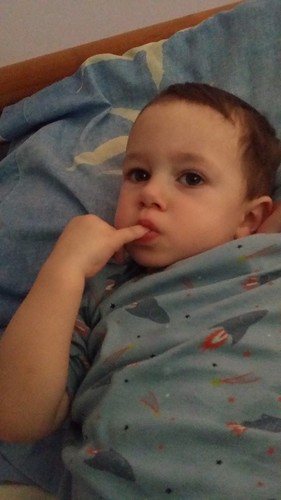
Jamie is working on his last four molars and his fingers are more or less permanently in his mouth.

Friday, November 03, 2017

28/52 2017

Week 28
10 - 17 July

I know I'm very late. I miss one week and then catching up is always such a daunting task. But the year is not over yet, so let's see if I can catch up.

Teeth cleaning

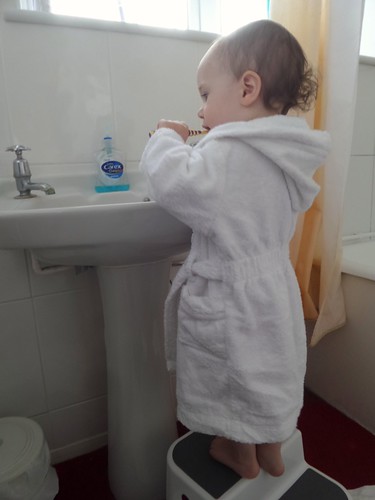
I've chosen this picture partly because Jamie is So! Big! standing on his steps to clean his teeth, partly because I love his bathrobe, but mostly because it's a good picture of his baby curls at the back of his head.

Thursday, March 02, 2017

1 in 200

I am still breastfeeding Jamie at 18 months old. First thing in the morning, last thing at night, during the day if he requests it.

This shocks some people, because in the UK it's a very unusual thing to do. Which is odd, because it's exactly the recommended path according to the NHS and the World Health Organisation. Exclusive breastfeeding to 6 months, then breastfeeding alongside other foods and drinks, ideally until at least 2 years, longer if mother and child both want to.

And yet.

The trouble with being 1 in 200 this way is that there's 199 mums who believe you're criticising their choices. So I get all English about it and make sure to validate their choices. I nod and smile and agree that whatever difficulties they faced were insurmountable, to the point where it was barely a choice at all. I imply that in their situation I would have likely made the same choice. I make cracks about how I'm only breastfeeding because I'm too lazy to sterilise bottles.

But a bit of me rages inside. I, too, had some difficulty getting started (I recommend the NCT Breastfeeding Helpline 0300 330 0771, and remember to use a phone that you can put on loudspeaker). I, too, would like to have a day off. I'd like my partner to be able to do the bedtime routine once in a while. I've made medication choices based on breastfeeding compatibility to the detriment of my own health. I've ridden out two bouts of mastitis during which, obviously, I had to look after Jamie even while hallucinating with fever. I've been bitten, basically once per tooth. Breastfeeding might be natural but it's not the soft option. I've worked hard at it and committed to sustaining it because every resource not sponsored by a formula company says it's the best and right and correct and most beneficial thing to do for my child.

It really upsets me that I then end up having to defend that choice, that effort. I've had people suggest that I do it because I want to delay Jamie's development. Or because I'm too possessive of him and don't want to let anyone else care for him. Or because it makes me feel important. Or because I don't know any other way to calm him down. Or because I'm an exhibitionist. Then we have the people who aren't so explicit about it, the double-takes, the "you're still breastfeeding him?!?" remarks, the queries about when I'm going to stop. It all grinds me down.

I'm not expecting a cookie - the cookie is knowing I'm doing my best for Jamie, and Steve gives me a lot of encouragement too - but less criticism and incredulity would be so nice.

Saturday, November 19, 2016

Breastfeeding Myths

All other things being equal, breastfeeding is best for babies. Current WHO advice is to breastfeed exclusively for the first six months, and then alongside other foods for as long as you and your baby both want to, which they suggest could be two years or beyond. There are many good reasons to choose breastfeeding.

There are also a lot of bad and misleading "reasons" that get spewed forth with the good ones.

1. It is cheaper because it doesn't require special equipment.

Unless, of course, you want to be at all comfortable and retain any dignity while doing it. In that case, you will need a full set of nursing bras, which means sleep ones and daytime ones, and because your body and breasts will keep changing size and shape, you need to get re-fitted every few months. It will cost hundreds of pounds and comes as quite a shock to those of us who, pre-pregnancy, were small enough that bras were more about decoration than support.

Then you need breast pads, to avoid getting massive wet smelly circles of milk soaking through those expensive bras and making stains on clothes and upholstery, and also to try and stave off the risk of infection. A box of 60 decent ones (like other feminine hygiene products, value-brand ones are false economy) is about £6 and lasts 15 days (you use two pads at a time, obviously, and if you have a day bra and a sleep bra that's two sets per day) so for the two years the WHO recommend you breastfeed, that's about £300.

You'll probably want some nursing tops as well, if you want to feed on demand and intend to ever leave the house. In summer it's not too bad, you wear a vest that you can pull down underneath a lightweight shirt or top that you can either open or pull up. The other 40 weeks of the UK weather year, I for one want my shoulders and back and tummy to stay covered. Not just for modesty either, although that's part of it. But hoicking up a winter jumper on one side means trying to feed the baby around a huge amount of smothering, view-obscuring cloth while half of your back muscles scream in lopsided agony from the chill. It's not a nurturing experience! So you need tops. At least eight, to start with, because you need to account for laundry turnaround time and additional changes due to vomit and other fluids. At £20+ each that's another couple of hundred pounds. But eight tops won't see you through two years. I'm embarking on my second winter and the tops I wore last year are... well... they look like they've had a year of hard wear and are nothing like as warm or as presentable as they were at first. Also, after a few months, while a body might not be quite what it was, it's not post-partum shaped so anything that was marketed for pregnancy *and* nursing looks ridiculous, with armfuls of cloth over a bump that no longer exists. People ask me when I plan to stop nursing Jamie and I'm only half joking when I say not yet, I've spent £150 on nice warm nursing hoodies so it'd be a terrible waste of money if I stop now!

You could get a nursing cover, although I wouldn't recommend it. And you're expected to take breastfeeding vitamins as well, at about £15/month that's another £360 over the two years.

Basically I want to bang my head off things when people assert that breastfeeding is "free".

2. It saves a lot of messing about with bottles and steriliser and so on.

True, but only to a point. If you have any intention of outsourcing even one feed over those 730 days, whether that's for your return to work, or to allow you to have a drink, or when you are sick, or to give other caregivers a bonding opportunity, you need a steriliser and at least one bottle set. These cost the same and take up space whether you use them three times a day, or three times a year.

If you want that bottle to be full of breast milk rather than formula then you also need a pump, hand or electric, and storage containers. We got a "breastfeeding support set" which was about £150. You need to find time to pump while also making sure the baby is fed - no good emptying yourself out in the half hour before the baby wakes! The baby probably won't sleep through the noise of the pump if you're in the same room, and once they're bigger, then trying to find a solid fifteen minutes do anything without their interruption is impossible. Finding time to pump if you don't already have childcare is a fine art. And then you've got to scrub and sterilise all the pump components as well... Once you enter the world of pumping, the "messing about with bottles" argument flies out of the window. As soon as there is a bottle, formula is infinitely quicker, easier, and involves less washing up.

3. It's more convenient.

Again, true up to a point. Yes, in the middle of the night it's a marvellous thing to not be trying to mix or warm up a bottle, instead just sleepily undoing your nightie and latching the baby on in seconds. But the real winners here are the dads. Not only does the baby stop crying sooner, they are off the hook for night feeds, because even if there's expressed milk ready to go, no breastfeeding mama is going to be able to lie still while her baby does the Hungry Cry while waiting for daddy to warm a bottle. Quite apart from the noise level, the sound of the hungry baby causes a physical response of milk production. Bottle-feeding parents can share night duties, when the family is sick then bottle-feeding parents can alternate shifts to each get a solid eight hours of rest. Breastfeeding mamas have no such luxury. Exclusive breastfeeding from source is wonderfully convenient for daddies.

4. Breastfed babies don't need burping and don't have reflux.

Bollocks. Go on, ask me how I know.

5. Almost any mother can breastfeed!

Also bollocks and a really nasty line to pull on women who want to breastfeed but cannot. Note please that I'm avoiding the even more awful caveat "for genuine/valid reasons" because, as with disability, who the hell is a stranger to decide what counts as valid? There's so many factors at play.

6. There's lots of support available!

True, but it would be more useful if it was at all consistent. New mothers get conflicting advice even before leaving the hospital, as different midwives have their different ways of doing things. Websites, breastfeeding counsellors, friends and relatives, everyone has an opinion and at least half of them will believe that whatever you're doing is wrong. The price of "support" is a lot of pressure. At least formula has unequivocal correct instructions on the tin.

Don't misunderstand, I feel very fortunate that I've been able to feed Jamie. I believe, even if I can't prove, that it's been instrumental in turning him into the happy, healthy, secure little boy he is. I feel like I've achieved something significant and that I've done right by him. But I feel like the pro-breastfeeding gangs devalue their message by diluting the genuine advantages with silly half-truths that don't stand up to scrutiny, and this fanatical belief that breastfeeding is the only important duty of a mother.

Saturday, August 20, 2016

If you were a parent you'd understand

One of the things that really irritated me as a childfree adult was being told that I could not possibly understand something - love, tiredness, forward planning, laundry, whatever - because I did not have a child.

As a parent, I'd like to reassure all childfree readers that there are only two things I "understand" now that I didn't before. These are:

1. The impulse to talk about poo. I've resisted the urge to post online about the contents of Jamie's nappies. His business is his business. On the other hand, as with all babies there are days when a particularly remarkable nappy really is the most interesting thing to have happened that day or when dealing with it without needing to nuke the site from orbit is truly an achievement, and at those times it is an effort to hold on to social proprieties.

2. The challenge of the nice cup of tea and a biscuit, an interesting combination of relaxation and stress. If you can pull it off, there's few things more restorative than a hot cuppa and a biscuit while the baby sleeps. But the tension is high, as one wrong move could wake the baby, resulting in a shortened nap, a screaming child, no biscuit and a cup of tea which, by the time the screams are quelled, has gone almost undrinkably cold. It's like the most incredibly mundane yet incredibly frustrating computer game ever.

Sunday, July 24, 2016

30/52

It has been too hot here this week. The Safer Sleeping guidelines say we shouldn't let Jamie's room get above 24c/75f - well, since Monday and despite our best efforts, I don't think we've managed to get anywhere in the house that comfortably cool!

On top of this, teething continues. He has two bottom teeth that are definitely fully out and visible from across the room. Then there's about five pale lumps on his upper and lower gums, with one sharp corner *just* beginning to poke through on the upper gum. He's doing his best, but it's obvious he's quite sore and he's pulling some spectacular faces.

baby chewing a pot of ice and water

But, we've done everything we can to keep him cool, and this is part of the effort. Half a dozen sterile storage pots, filled with water and then frozen. We've allowed them to partially melt before giving them to him, and they seem to have helped a great deal with both the temperature and the teeth.

I hope both issues resolve themselves soon though, and if anyone has any tips we might not have thought of, do let me know!

Monday, September 21, 2015

An Update

In my last few posts, I talked about three major obstacles to the baby preparations.

One was the difficulties of getting assessed for a suitable wheelchair. After my last post, a number of people gave me details of companies and charities who had been useful to them. Sadly when I followed up these leads, some weren't able to help, and others were unhelpful by choice, showing me the chairs they wanted to sell rather than the chairs that would meet my needs, and calling it an assessment.

Thankfully, this turned out to be the easiest situation to resolve. The experiences with the "assessors" convinced me that I might as well ditch my fear that going into a mobility showroom would leave me prey to unscrupulous salespeople. I called a local showroom, explained my needs, and arranged an appointment. When I arrived, the salesman had several chairs lined up that did meet my specifications. After a bit more discussion and measuring, I was having a test ride, which included seeing if my favourite one would fit in the car. It did. The salesman then encouraged us to take our time, go home, have a think, and phone him on Monday if we wanted to buy it... and a brand-new one was delivered by him to our house at the end of that week.

I'm gradually getting used to it and I think it's going to meet my needs well.

There was Social Services, where "my" social worker had gone off sick less than three months into my pregnancy. The refusal of Warwickshire Social Services to transfer my case to a different social worker "because she'll be back soon" meant that I had no support at all until my pregnancy was past the half-way point, at which stage it was conceded that the Duty Social Worker team could help out with my case if they had time. I saw a Duty Social Worker at 26 weeks pregnant, but at the time of my last post, I wasn't confident that it had gone well.

At 32 weeks and with my assessment still waiting to be seen by the decision makers, my Health Visitor decided to see if she could intervene in any way. She was told that "my" original social worker was due back in the office any day and would definitely call her back as a matter of urgency. Except of course that this was every bit as much a lie as it had been every time I'd been fobbed off with it during the Spring.

Then at 33 weeks pregnant, for reasons it's probably best not to speculate on, I was officially reassigned to the proper caseload of the social worker who had been the Duty Social Worker who had seen me almost two months earlier. A few days later, I was given a date for my caesarean section which will be at about 39 weeks. I'm not sure if this deadline helped - at 35 weeks pregnant, with four weeks of pregnancy remaining, I think my assessment for additional support during pregnancy was very nearly ready to be submitted to the panel...

On the bright side, the Health Visitor and the no-longer-duty Social Worker are liaising directly now, and I think the midwife might be as well.

Which means I'm free to worry about the stairlift. At the time of my last post, after the delays caused by the absent social worker situation, we had sped through the assessment process thanks to a helpful and super-efficient OT and were awaiting a quote, which arrived, as it was supposed to, just before 28 weeks of pregnancy.

We signed, wrote a cheque for a deposit of over £2,000, and got it back to them next-day. According to the contract, this meant installation would happen within 6-8 weeks - so at the very latest, before 36 weeks of pregnancy (or "well before the end of September" for those of you who prefer a traditional calendar). It was cutting it fine, but it would be okay.

We were quite surprised to then be offered an installation date in the middle of October, or 39 weeks of pregnancy.

There were two problems with that.

One was that it was 3 weeks over the maximum 8 weeks promised in the contract, which really is not good enough when you are forking over five thousand pounds for essential equipment. I signed that contract on the understanding that my stairlift would be installed within the timeframe specified in the contract.

The other was that the date they were suggesting was the actual date for which my caesarean is booked.

After a lot of phone calls (which is always me phoning them, because their inability to stick to their own suggested timescales extends to calling back when they say they will), they have managed to rearrange for installation to happen in the first week of October. This is still breaching the contract - but I don't have the choice to make a big deal about that, because I need a stairlift in place before the baby gets here, and it is too late to get one from a different provider.

I am in my final month of pregnancy. I am supposed to be thinking nice, nurturing thoughts, and doing gentle exercises, and nesting. If I was at work and experiencing this kind of stress, I would be advised to start my maternity leave now. But there's no maternity leave from this situation.

Friday, May 08, 2015

Testing

The other day I blogged about my private scan, and the joy of it, but also my misgivings about the way private healthcare uses fearmongering to boost profits - in this instance, by telling pregnant women that "time was running out" for them to get tests not routinely offered by the NHS.

These misgivings are reinforced when I'm on forums with parents-to-be from other countries who are dependent on less-than-stellar private healthcare packages and are having to approach all tests from a position of "can we afford it?"

So I feel wonderfully lucky to have the NHS, offering testing and screening and scanning and measuring for all sorts of things. Obviously (I hope obviously) I'm entirely against the idea of aborting a foetus for having a disability. On the other hand, I think it's a damn good idea to know if there's a treatable medical issue endangering the life of the mother or the baby. On the other other hand, screening tests are imperfect (screening determines only likely/unlikely, secondary testing is required to obtain a yes/no) and being told your pregnancy is "high risk" for something can cause a great deal of often-unnecessary worry. On the other other other hand, I can really see the logic of being able to research and prepare ahead of time for a baby which will have complex needs from birth...

It's an incredibly tangled and emotive issue, and one that it's very difficult to discuss without encountering distressing invective about disability, abortion, women's rights to make decision about their own bodies, shaming, blaming, name-calling and all sorts of other unsavouriness.


Weirdly, for me the decision has been made vastly simpler by being disabled. I know ahead of time that when I get past, say, week 38 of 40, I'm going to become difficult. At the absolute very minimum, once the baby is born and I'm on the ward, I'm going to need my wheelchair and/or walking frame beside the bed - and every disabled person reading knows that hospitals don't like you bringing your own (I think it's a philosophical problem as much as a space and hygiene issue). When I use that wheelchair or walking frame to get to the loo, I'm going to need the staff on the ward to understand that it's not appropriate to tell me that having had a baby doesn't make me disabled and to just walk properly. I may have to determine whether my PA counts as a visitor because while I'm wiped out I'll need advocacy. There's all sorts of stuff, none of it insurmountable, but all of it needing to be addressed.

So, up until the point at which I really really need to raise my head above the parapet and start being (what I fear will be construed as) fussy and awkward, I feel I should be as compliant as possible with the non-invasive testing. Build up my credit, sort of thing. For every single test, the accompanying leaflet reminds you that you have the right to refuse, but I feel that it will serve me better not to have "refused testing!!!" or worse, "has internet access" written on my notes, you know?

Tuesday, July 15, 2014

Coombe Country Park

This weekend Steve and I had a friend come to visit, and the three of us went to Coombe Country Park. It's very pretty and a really nice place to spend a sunny day. Entry is free, parking is the really quite reasonable sum of £1.90, and access is pretty good as these things go. It's "natural" paths rather than tarmac, so not the smoothest of rides, but in the dry weather the easy access route is very do-able and the medium access was what I would describe as bumpy, but possible with assistance.

I needed assistance three times.

The first time was to go over a bridge. The gradient of the slope up was just a little more than I could comfortably manage... I probably could have done it but there's no prizes for hurting yourself when you're with people who are entirely happy to give you a boost.

The second time was to go down a slope where the path had a deep rut all the way along the centre, presumably caused by a combination of feet, bikes, and from the look of it I suspect water when it rains. It was just a bit too wide for my chair to go astride it, and there wasn't quite enough space for me to go down one side of it - especially once nettles, tree roots, patches of loose pebbles, patches of loose sandy soil, etc got factored in. So Steve took my chair down and our friend took me, and we all made it safe and sound to the more solid path at the bottom of the hill.

The third time... the third time was the most terrifying, but was nothing to do with the park itself. It happened, of course, at about the furthest point of the two-mile medium access loop around the forest and conservation area. My left front wheel started making a funny noise. The funniness of noises is a bit subjective when you're talking about hauling a four-year-old cross-folding wheelchair along a forest track, but this was a really funny noise with more than a hint of ominousness. I looked down, and noticed that one of the two bolts holding the left front wheel unit on was sticking out by just over an inch. I put my brakes on, reached down, and caught the bolt as it came out completely and the whole wheel unit flopped.

Things got worse as I examined the bolt and saw it required an allen key. Although I had two pocket multitools with me, furnishing an assortment of screwdriver heads, cutting blades, bottle openers, tweezers, pliers, etc... the nearest allen key we knew of was in the car. Which was at least a mile away over terrain which in one direction was completely unknown and in the other direction would include going up the slope that I'd already needed help to get down.

I got out of the chair again and we all took a closer look to see how much of a field job could be done with the tools we had available. We hadn't lost any bits, and it seemed to have simply untwiddled itself rather than having sheared away or anything, so that was good. Unfortunately, Steve realised that lining up the bolt that had come out would mean undoing the second bolt as well to take the whole wheel unit right off, in order to align the whole thing properly for both bolts to go in together.

Being out and about, especially in nature-type places, always gives me a sort of thrill that people who've never been housebound don't quite get. Look at me, how daring I'm being, not only out of the house, but a mile or more away from the nearest car. Which is great until the point you're sitting on a dirt path, knowing that yes, that's right, you're an actual mile or more away from the nearest vehicle, and trying to stay calm while someone fully detaches a wheel from the object you depend on not just to get back to a place of safety but to move around independently once you're there.

Of course it could have been worse. There were three of us. It was a sunny, dry day with about eight hours until sunset. We were on an "official" path, we had phone signal, a picnic blanket, and plenty of water. I was hardly at risk of life or limb. I trust Steve, and I know that he has more mechanical ability than I do, and I know that he's read the manual, and I know he won't put me at unnecessary risk. I was happy to let him lead the repair effort, and he kept me informed and waited for my permission at each stage. Even so I was only one notch off a panic attack at the point the wheel was entirely removed.

Thankfully my faith was not misplaced. Within a few minutes Steve had got the wheel back on and we were able to move again, albeit somewhat cautiously and with all three of us continually peering at the chair every few minutes. The rest of the path was much kinder, and bit by bit we reached the visitor centre, got some lunch, and then I installed myself on the picnic blanket within not just sight but wobbling distance of the car.

On our return home, Steve tightened up every bolt he could find on the chair, using the Official Toolkit. Apparently most of them were pretty tight and the ones on the right front wheel were basically immovable, so we don't know why the left one managed to work loose.

The bad news is, now the car has started making a funny noise.

Friday, April 11, 2014

Doorbell: a revision

I waited oh-so-patiently for the sugru to set. The full 24 hours, and then an extra night's sleep to be on the safe side and to share the trial run with Steve (only fair since it was him who sourced the doorbell itself and created the mp3 for it to play).

Ha.

The sugru blob I'd made - thick enough to accommodate the smiley face drawn onto it - was, when set, too thick to be flexible enough to push the doorbell-button through it with a single finger. It was also too large in diameter to press the button with it, as the whole red circle couldn't go into the casing.

I haven't explained that well, but the upshot was that the only way to press the doorbell was to hold the unit in your hand and squeeze as hard as possible. Not really practical.

In retrospect, the sugru blob needed to be smaller than the original button, or thin enough to be bendy, or both. At least, unlike with the daffodils I ruined, I know what I did wrong.

Thankfully, the folks at sugru are aware that their products may be used by the inept and hard-of-thinking and give tips on their website for how to remove it. A few minutes of running my fingernail around and around the red button loosened it enough for me to be able to peel it away.

As a happy side effect, the previously white button has taken on some of the red hue from the sugru, making it visible - which was the original aim.


I've managed to correctly spell my name, so that's something.

Saturday, August 25, 2012

Bad Sexual Etiquette

Warning: this post is about rape issues.

If you are affected by rape issues you may wish to visit the Rape Crisis website (England and Wales).


It doesn't really matter who he is. Maybe he's your boyfriend, of weeks or months or years. Perhaps he's the old schoolfriend who you met again a few hours ago downstairs at the party. Perhaps he's a "friend-with-benefits" who you've known for years. Maybe he's your husband. Maybe he's the man you don't want your husband to find out about. Maybe you've had sex with him before, maybe not.

It doesn't matter. He's a nice guy. You have no reason to think badly of him. Your taste in men is surely not that bad. You've dumped plenty of idiots and refused to even consider dating plenty more. This one has passed the filters, and you want to have sex with him.

That said, you want to use a condom. Again, it really doesn't matter what your reasons are. Maybe you want to avoid disease. Probably, you don't want to risk getting pregnant. Perhaps you're feeling aware that it would, for whatever reason, be awkward for you to try and get hold of the morning-after pill. Maybe you're on the everyday pill but you missed one, or are just wanting that extra layer of reassurance.

So you're kissing him, and both of you are enjoying it, and you want to have sex, but you slam on the brakes and one way or another you raise The Condom Question. And despite the hormones and desires and excitement, you refuse to go any further until he's agreed and there's a reassuring square foil packet sitting ready on the bedside table (or the dashboard, or the refreshments trolley in the company boardroom, hey, whatever works for you).

Then, with gleeful abandon, the brakes, and the rest of your clothes, can start coming off. You're excited. You're aroused. You are spread out, relaxed, enjoying all sorts of foreplay and eager to have wonderful, enthusiastically consensual, penetrative sex.

And he's between your legs
Oh!
kissing his way up your body
amazing kisses
making you feel fantastic
and suddenly
no, he can't be
he's pushing into you
he wouldn't
and the little foil packet is still sitting there, unopened.

"No!" you say, and your voice sounds like it's coming from a long way away, so you try again, "no, we need to use a condom..."

"It's okay," he says, his familiar, nice-guy face smiling over you.

"No, it's not okay!" you shout? whisper? not even sure any more and you try to push him away but your muscles won't work properly even as he caresses your useless spaghetti arms and gently, almost lovingly, but quite firmly enough, holds them down over your head, and tells you to relax I would relax if you would just put the bloody condom on because he's not going to come in you.

As if that makes much difference. You were awake in sex-ed class, you had it drilled into you that pregnancy and disease are possible from pre-ejaculate. You're certain that at this point in your life you don't want to deal with the mental and physical strain of a pregnancy, or an abortion, or childbirth, or raising a child, or giving a child up for adoption. This is not a risk you wanted to take.

But "no" hasn't worked and I can't move and my mind is whirling too much to give a lecture on sexual health issues...

His face is still over yours. He's still smiling, still kissing you, mistaking your panic for pleasure. He tells you that he wants to feel you orgasm like this orgasm? I'm not even turned on any more and with a shiver you realise that if you can't physically force him off you then the only remaining option is to fake it, get it over with, quickly as possible, minimise the risk, get him off me.

So you breathe, and you try to ignore the little voice that's screaming getoffme getoffme getoffme and you say oh, mmm, yes, NO! and flex your Kegel muscles as best you can until oh thank god he's convinced, and he withdraws, and the smile on his face tells you that your faked orgasm has reassured him that you actually really enjoyed that experience when in fact you're lying there still and boneless and in shock, trying to process what's happened.

He didn't come. Do I still need the morning after pill? Would I even be able to get hold of it without admitting what's just happened? Am I prepared to take the risk? How do I arrange a sexual health screening without anyone finding out? What's an abortion actually like? First things first, what's the date, how long until my next- WHAT THE FUCK IS HAPPENING NOW?

What is happening now is that he's pushing into you again, and this time he's wearing the condom, and you are expected to be grateful for this can't be happening, can't be happening, can't be happening you feel sick and your stomach muscles clench and you gasp for breath and this is also interpreted as excitement and finally he comes and he withdraws and this time you practically leap off the bed and get your clothes back on and you're out of the room in ten seconds flat even though your arms and legs still aren't quite doing what they're told.

He follows you. He's the clothed, smiling man who not half an hour previously was an entirely nice chap, talking to you and making you smile and showering you with affection.

He doesn't think he's a rapist.

Do you?


Tuesday, June 12, 2012

Problem?

The big line being pushed by our beloved government this week is about "problem families" and the need to "crack down" on them. The right-wing press have seized on this, breaking out charming descriptors like "Britain's worst scumbags". There are apparently 120,000 of them, costing Our Brave Nation £9bn every year. Even the supposedly-neutral BBC agrees, although by now their oft-used phrase "according to ministers" basically translates as "you might want to take this with a pinch of salt."

So, what makes a "problem family"? How do we define the country's "worst scumbags"?

Well, that's where it all gets a bit runny. No one's quite sure where the figures of 120,000 and £9bn have come from - those ministers so keen to make these assertions aren't so keen to have their assertions examined and have not been forthcoming with their sources. Fullfact.org have given it their best shot and come up with the 117,000 families in England classed as "Families with Multiple Problems" as the nearest likely contender. The definition of that is clearly set out. An FMP is a family that matches at least five of the following seven criteria:
• No parent in the family is in work
• Family lives in poor quality or overcrowded housing
• No parent has any qualifications
• Mother has mental health problems
• At least one parent has a longstanding limiting illness, disability or infirmity
• Family has low income (below 60% of the median)
• Family cannot afford a number of food and clothing items.

This quite surprised me because by that yardstick, I spent most of my teenage years in an FMP. My mother was not in work (1) due to her longstanding limiting illness, disability or infirmity (2) which meant that once my father was gone, we were a single-parent family reliant on state benefits which were a low income (3). We had difficulty affording proper food (a regular meal was "pasta and gravy", no meat or vegetables, which I didn't even realise was unusual until I was 19) and most of my clothes were second-hand (4). And our house was in a pretty awful state of repair, cracked windows and dangerous electrical wiring being two of the simpler issues (5). Ding, Family with Multiple Problems.

Eric Pickles, the Communities Secretary, has been ranting about these families not in terms of their circumstances, but in terms of their behaviour - crime and social disorder, truancy, alcohol abuse, and "ruining the lives of their neighbours".

Hmm. My sister and I were never in trouble with the police, we always had a parental note on the rare occasions when we missed school, the only alcohol in the house during our teenage years was the occasional bottle of wine given to our mother as a gift, and we got on well with the neighbours on both sides. We performed well in school, engaged in extra-curricular activities, got home by our curfew and were basically normal, boring, well-behaved kids.

Which on one level is admittedly irrelevant. My personal circumstances are anecdote, not data. To examine the data, go back to the Fullfact article, which is excellent in that regard and links back to all manner of primary data sources, and indicates that the number of FMPs which also have children exhibiting problem behaviour is closer to 46,000.

What I can say - anecdotally - is that while my teenage self would have accepted the descriptor "Family with Multiple Problems" as an unpalatable but undeniable truth, she'd be rather upset by the idea that to live with those problems was interchangeable with behaving in an antisocial or criminal manner. When getting home at 5pm after doing her homework on the school computers with a bunch of other kids in similar circumstances, she'd be quite put out by Mr Pickles' view that children like her needed to get their truancy under control. When babysitting, for free, the child of someone who volunteered one evening a week at a social group for people with learning difficulties, she'd be quite angry to hear Prime Minister David Cameron assert that people like her and the person she was babysitting for were creating "a huge amount of social problems, for themselves but also for the wider community".

Please, please, please, can we stop conflating "poverty" and "immorality", "lives with problems" and "is a problem", and "not in paid employment" and "does nothing of any use at all."

Tuesday, April 10, 2012

Inaccessible Accessibility

I am, and have been for some years, a holder of a Blue Badge. The Blue Badge is a wonderful thing for access. My badge is up for renewal in a couple of months, and Warwickshire County Council have very helpfully (credit where it's due) sent me a renewal form and some guidelines.

They need proof of:
  • My name, in other words my marriage certificate.

  • My address, in other words my council tax bill.

  • and my eligibility, in other words my letter confirming my award of Disability Living Allowance including the High Rate Mobility component.

So far no problem.

BUT!

They don't want the responsibility of handling original documents. They want me to send certified copies.

Okay, that's fairly sensible too. I prefer to keep my original documents in my own posession and I appreciate the effort to reduce the risk of losing them.

According to most of the UK, a certified copy is a photocopy of a document that has been verified as being true by a person who holds a certain position of responsibility. A doctor, a policeman, an MP, a civil servant, you get the idea. The Jobcentre made a certified copy of my marriage certificate when I went in to change my name. Or, that proud institution the Post Office will make certified copies of up to three documents for the fairly reasonable sum of £7.15 as part of their passport and identity services.

These certified copies are good enough for most institutions and can be used for opening bank accounts or getting mortgages, but apparently they're not good enough for Warwickshire County Council's Blue Badge scheme. Warwickshire County Council insist that the certified copies must be made by someone who not only fits the usual criteria, but also knows me personally and is not a relative.

(Amusingly, however, I can self-certify my own photograph for the badge as a "true likeness" without it having to be corroborated by anyone.)

I couldn't quite believe it and phoned them to check. The conversation went a little bit like this:
(Me): I'm a blue badge holder. I don't drive. I'm written up as "socially isolated" on my care plan. I don't know that many non-relatives. Can I bring in my original documents to your offices and wait while you copy them?
Only if you know someone here who can confirm that you are who you say you are.
Oh. No, I don't. Well, can I send normal certified copies from the Post Office?
Do they know you personally at the Post Office?
No, but they do proper legally acceptable Certified Copies...
They have to actually know you and be able to confirm that you are who you say you are. We've had to introduce these measures to combat fraud.
But you seem to have made it difficult for precisely the people who the scheme is aimed at! The reason I don't know people is because it's difficult for me to get out and about!
I can't discuss policy. There must be someone. Your best bet is someone who owns a local business. Do they know you at the local shop?
No, they don't know me at the local shop, because I'm a blue badge holder and as such I don't walk to the shop.
Or your bank?
I bank online. I shop online. I work online. I do most things online, because it's really difficult for me to get out and about and that is why I have a blue badge!
If you're working, how about your boss?
I am self-employed. I don't have a boss and I doubt you'd let me self-certify.
Anyone you know through work who runs their business?
Clients? Some of them would be eligible, but most of them have never met me, because I work online, what with the whole being eligible for a blue badge because it's difficult for me to get around issue. They only know me on email and phone calls.
But they know that you're you - they can do it!
May I ask you a question? Imagine you have a business. Imagine you try to project a professional image to your clients of being capable and self-sufficient. Would you feel comfortable placing yourself in a position of need? Giving one of them your disability benefits confirmation letter to thoroughly examine?
er... I see the problem but it looks like that's what you're going to have to do.

Warwickshire County Council, ladies and gentlemen. Recommending that I go whimpering to my clients. Advising me that I am obliged to do this in order to obtain an access tool. Refusing to accept the perfectly accessible and inexpensive identity-checking service offered by the Post Office. Creating additional barriers. Well done, boys and girls.

There is a happy ending. Another disabled person is helping me out. That doesn't make Warwickshire County Council's attitude acceptable.

Now, to take a deep breath and try to rewrite this post in a less ranty form, in the hope that explaining their error to Warwickshire County Council might lead them to change things in future.

Wednesday, January 18, 2012

I'm confused by the BBC

The last couple of weeks have seen the Coalition's Welfare Reform Bill (WRB) being voted on in the House of Lords.

There are two main aspects of disability benefits. First is ESA, Employment Support Allowance. This is the money given to people who are unable to work because of illness or disability. Then there is DLA, Disability Living Allowance. This is the money given to people regardless of their income or whether or not they are in work, in recognition of the increased costs that come with disability.

It is possible to get both; it is also possible to be eligible for either one but not the other. I myself get DLA (because I have substantial disability-related costs) but not ESA (because I am working).

Part of the WRB includes plans to replace DLA with PIP, Personal Independence Payments. One of the stated aims of the WRB is to reduce the DLA spend by 20%. Since the DWP's (Department of Work and Pensions) own figures show that fraud is only 0.5%, this means that genuinely disabled people are going to be hit by this - which is why we're all worried.

(Is everyone keeping up with the abbreviations at the back? A cynical person might think that part of the reason for renaming as well as reforming this benefit is to make it far too complicated for the average news column to be able to report on.)

Disability campaigners have been asking for a six-month pause to the WRB so that a proper independent consultation can be carried out, and to start the change slowly with a pilot project to uncover and iron out the teething troubles. We are of the opinion that if the government is going to fiddle about with the benefits that support the most vulnerable, most disabled, and/or most ill people in the country (including many who are terminally ill and only claiming for their last few months of life) they should think really carefully about it and be sure that they will do as little damage to as few people as possible.

Last night, the Lords voted. The government won, by 16 votes, the WRB rattles on to the next stage. The good news is that in order to swing the vote, Lord Freud had to make an awful lot of promises - under oath and on the record - about the implementation of PIP. Our amendments aren't passed, but some of what we were asking for in them has been conceded, and that's more than many of us expected.

What does the BBC have to do with this?

Well, the BBC is confusing me.

First, they ignored the issue. If you were on Twitter, you can't have missed the #spartacusreport hashtag that was top trending in the UK for most of last week. It refers to the Responsible Reform report. Auntie Beeb had time to do all sorts of analysis about middle-class shoplifting, but did not so much as acknowledge our existence.

Then Radio 4's News Quiz did sterling work using comedy to demonstrate exactly how ridiculous the proposals are. Hat-tip to Sandy Toksvig and Sue Perkins in particular.

But from there on in, and in the sections of the Corporation that are defined as News rather than Entertainment, it's been the government line all the way.

For instance, Maria Miller, the person who is laughably job-titled Minister "For" Disabled People, was given unchallenged airtime to claim that Responsible Reform had only used 10% of the responses to the initial WRB proposals. Technically, that's true. There were over 5,000 responses and we only used about 500. Why? Well, the 500 responses we were allowed to use were official responses from "public" people like the Mayor of London (who objected to the proposals on several counts) and organisations like the Papworth Trust, Mind, and Scope (who also objected to the proposals on several counts). The report uses all of the "official" responses to which we were granted access. However, for obvious reasons, we weren't allowed access to the private responses from private individuals. This includes the responses from many campaigners who had written to describe how they, personally, as individuals, would be affected and what their fears were. Yet to hear Miller speak, you'd think we'd cherry-picked a tiny number of supportive statements and ignored thousands of reports in support of the WRB.

Where was the balanced reporting? Where was the skeptical journalist to ask Miller if the thousands of private responses we weren't allowed to use were broadly for or against the government proposals? Why are her vague and often misleading comments allowed to pass unchallenged?

And then this morning, this article (which I'm copy/pasting from in case it gets edited in future, as the BBC often do):
"The government has headed off a House of Lords defeat over plans to replace the Disability Living Allowance.

Ministers want to amend the system to make sure claimants undergo more testing, but opponents say this will mean 500,000 people will lose benefits."


Firstly, the 500,000 losing benefits. The WRB has a stated aim to reduce DLA by 20%. There are 3.2 million people on DLA (source: dwp.research.gov.uk); a 20% reduction is therefore 640,000 genuinely disabled individuals. So we say that the WRB - not the testing - will mean 500,000 people lose benefits partly because it's a nice round number and partly so that no one can accuse us of over-egging the pudding.

Secondly, ministers do not want to make sure we undergo more testing. They want us to undergo different testing (for which they will pay a private company because they think asking our NHS doctors for medical evidence is inappropriate) and they want us to undergo more frequently repeated testing.

We have said that making claimants with incurable conditions undergo frequently repeated testing is a waste of governmental time and money ("no, my leg still hasn't grown back").
We have also said that, particularly with regard to people with mental health issues, too frequently repeated testing causes distress to claimants which may impair their recovery.

We do not pretend, nor have we ever said, that making claimants undergo more testing will mean 500,000 people losing benefits. Those two items don't belong in the same paragraph, let alone the same sentence.

You get the idea. There are scores of examples just from the last two days - far too many to deconstruct all of them. We are not seeing balance from the BBC. First we were dismissed and ignored, now we are being misrepresented as ill-informed scare-mongerers making disjointed and illogical claims that we have never made, while Miller and her ilk are permitted to broadcast spin and propaganda that the WRB itself and the DWP's own statistics disprove.

The reason I feel upset by this behaviour from the BBC when I can usually ignore it from the Daily Mail is the same reason why I feel more betrayed by the 65 Liberal Democrat lords who voted with the government than I do by the 150 Conservative lords. When people or organisations behave in the way you expect, it doesn't bother you - but when people or organisations you believe in let you down, it stings.

We don't expect the BBC to support us, but we expect neutrality, balance, investigation, factual reporting. We're obviously upset that the Lords' vote went against us, but the way the BBC are treating and portraying us only increases the negative image of disabled people and adds insult to injury.

Friday, November 04, 2011

Disabled, not dead

Yesterday, my Twitter feed was alight with people being gobsmacked by the content of Panorama's so-called "investigation" into benefit fraud. Interestingly, I understand that neither of the major culprits "investigated" and plastered across the BBC's prime viewing have actually been charged with benefit fraud. More worryingly, it appears that several of the activities the "investigator" took umbrage with weren't actually activities that would preclude a benefit claim...

I didn't watch the programme, in the end. Being, y'know, disabled and all, watching lengthy TV programmes late in the evening isn't something I'm very good at. I was going to catch it on iPlayer but have since decided that it will only upset me. So I want to make clear that this post is not a complaint about the Panorama programme because complaining about a programme I didn't watch and don't intend to watch seems rather ridiculous.

But I am qualified to comment on some of the urban myths surrounding disability, because they do impact me and my friends on a pretty regular basis. Facts and figures unless stated otherwise are drawn from HM Govt's Office for Disability Issues overview of official disability statistics, which can be found here.

Myth #1: Disabled people claiming benefits do not work.
In fact, about 48% of disabled people are employed (although this is compared to 78% of non-disabled people). Disability Living Allowance (DLA) is not means-tested and is awarded based on the impact a person's impairments have on certain aspects of their day to day life, such as washing, dressing, cooking, communicating and moving around. Disabled people often incur unavoidable expenses in trying to meet these essential needs, and DLA recognises that it is unfair to attempt to force working families and individuals to try and meet these non-negotiable and unasked-for additional costs out of their earned wages. Some disabled people work and claim Tax Credits, which is another legitimate form of benefit available to working people. And ESA has provision for Permitted Work for people who can only work very limited hours or in a very supported environment.*

Myth #2: Disabled people are obliged to be poor, and may not own assets.
While "a substantially higher proportion of individuals who live in families with disabled members live in poverty, compared to individuals who live in families where no one is disabled," wealth does not make a family immune to disabling illnesses or injuries. If you own your own home and live in it, then in the long run it's cheaper to let you carry on living there as long as possible than to attempt to rehouse you and have to pay Housing Benefit to you once the capital has evaporated.

Myth #3: Disabled people should not engage in physical activities.
Show me any person with an ongoing long-term physical or mental health condition, and I'll show you a person who has been advised by their medical professionals to take up swimming and/or gardening and/or going to a gym in the hope of staying active and healthy in so far as that's possible. It's always recommended, even if it doesn't get formally funded by the NHS under the guise of physiotherapy. Also: Paralympics, anybody?

Myth #4: Disabled people should not have a good time.
This is the most ridiculous of all - the idea that if a disabled person attends a party, or goes to the pub, or goes shopping, or is seen outdoors laughing with their friends, it's an affront to all right-thinking taxpayers and incontrovertible proof that "there's nothing wrong with him".

We live with our conditions. It's not like being sick and miserable for three days, but it's also not like being sick and miserable for three decades. It's more like being sick and miserable for three months, getting an idea of what's happening, spending three months in a horrible chaotic whirl as you realise your life is changing forever, taking anything from a few months to a few years to grieve and come to terms with what is happening to you, and then... you live. Which means you grab every opportunity you can to have a good time and laugh with your friends, just like any other person. You abandon the "miserable" by the side of the road.** We laugh. So sue us. We're not locked in a box out of sight. We're disabled, not dead.


* This is a gross over-simplification because to properly and fully explain would take another ten blogposts.
** At least until the next time you find yourself and your community under attack in the media.

Wednesday, September 07, 2011

Second lesson

I recovered pretty well from my first riding lesson. On day 1 I had sore muscles, but nothing too upsetting. On day 2, my muscles had settled down considerably, but my ME/CFS symptoms (sore throat, headache, etc) flared. But on day 3 I was back within normal parameters.

Today was my second lesson. There were good bits and bad bits.

Things started off well. I got onto the horse correctly and was led into the school. I was sitting much more comfortably, I was wearing different shoes and I think that helped my position. I remembered how to hold the reins, and I felt good and confident and totally ready to balance on top of Harvey as he went round and round the school.

Then I realised that, although the instructor (different instructor today) was going to be walking around with me, Harvey wasn't actually on a lead rein. I was supposed to be in charge of getting him to go and stop and turn.

In many ways this makes sense. A lot of how you're supposed to communicate with the horse about going and stopping and turning has to do with how you sit and conversely how you sit is going to be communicating with the horse. So it's a bit unfair and confusing and counter-productive for all concerned if the horse is being tugged left by the instructor when everything in the rider's body is saying Turn Right (and the newbie rider doesn't realise that's what she's doing). It's also about as safe as it could be - unlike cars, horses don't tend to crash into walls when you get something wrong.

However, all the sense in the world could not quell my rising sense of panic. I wanted to beg them to just let me get "sitting" nailed before I tried actual "riding". I was genuinely surprised when my pride and positivity managed to get in between my brain and my mouth, to morph the phrase "no! nooo! let me off! can't do it! don't wanna!" into "okay, absolutely, so what do I need to know?"

To my amazement, I did manage to persuade Harvey to start and stop and turn and change direction several times. But what we then experienced was a clash between my ability, and the principles of teaching.

Principles of teaching are to keep pushing the student to improve. Sit up straight - good! Now put your shoulders back - good! Now try and have your hands about the same width apart as his ears - good! But don't look at the horse, or at your hands, keep looking where you want to go - good! Let your hips move - good! Aim towards the H - use your outside leg - don't lean forwards...

My ability considered on a scale of 1-10 where 10 is my top performance, probably started at about a seven. I got on the horse, I warmed up a bit, my confidence grew, I got a few things right, and I was functioning at a ten! for ooh, maybe a minute and a half. The demands of the teacher increased. My brain was trying to handle more instructions. My body was getting tired. Gradually my ability dwindled to maybe a three. I was dizzy and not breathing well because I was holding my breath as I tried to follow all the instructions at once. We rounded another corner and I was trying so hard to remember which is my "outside leg" that my concentration on sitting up straight all but vanished, and whichever leg it was, the passable squeezes and kicks I was managing at the beginning of the lesson had turned into rather pathetic flops.

At this point Harvey quite reasonably decided that in the absence of a decent rider or a lead rein, he certainly wasn't going to be taking half-baked instructions from the weak and wobbly sack of jelly perched atop his saddle. His walk slowed to a meander and eventually stopped altogether. With the instructor, the supervisor, and the people who were there for the previous and next lessons all calling out words of encouragement, I got another few metres out of him, but by that point I was just burning with humiliation and wanted to not only slide off the horse, but continue right on into the ground.

Of course the ground doesn't work like that, and neither do horses. It's surprisingly difficult to fall off a large horse when you're sitting comfortably with a leg either side and he's standing still, and given a choice, I'd rather not cover my clothes in grubby sand/sawdust/whatever it is. My chair was still outside by the ramped mounting block and my walking stick was in my bag which was hanging on my chair, so I was sitting up there in front of the audience as I waited for someone to bring me one or the other and help me dismount.

I managed to get down more easily than last time, although I still needed help and was hardly elegant. As I joined the other students, a couple of them made sympathetic noises about how difficult it is when you're first learning... but this didn't help, as my tired and embarrassed brain, a hair's breadth away from bursting into tears with frustration and exhaustion, could only hear that people who'd watched my efforts had found me so utterly incompetent that they could only offer pity about just how awful I was. I paid and booked my next lesson as quickly as I could and then went and sat in the car park so that I wouldn't have to talk to anybody for the half-hour until my taxi arrived.

Of course after getting home and having a rest, a cup of tea, and a spot of lunch, I can acknowledge how ridiculous this was (I could sort of acknowledge it at the time but it didn't help). It's not the job of the other students to praise or encourage me, they were trying to be nice and I was behaving like a bit of a twit to run off and hide from the world. It was my second ever lesson, and I did about as well as anyone can be expected to on their second ever lesson. I can even - grudgingly - accept that I do have an illness with physical and cognitive components, and that my rapidly dwindling ability in the latter part of my lesson was to be expected and will probably happen again.

What would be useful is if any readers who've done/are doing horse riding could give me a clue how long I should persevere before I say "no, clearly I'm not cut out for this and should call it a day." When does it become fun rather than a confusing, exhausting struggle?

Tuesday, August 30, 2011

Restrictions Apply

Sometimes I find it quite difficult to use social media, as a disabled person. Not so much on a technical level, as on a privacy level. How much can I share with which people? How can I try to be sure no one gets the wrong end of the stick?

As a recipient of certain kinds of disability assistance I have to be aware that I may, at some point, be the subject of an investigation without my knowledge. That's not paranoia; the DWP quite openly advises that (over and above investigations of individuals reported as potential fraudsters) it regularly carries out checks on random samples of claimants. I'll be surprised if, in 2011, this doesn't include checking social media use.

I have nothing to hide. However, social media centres around succinct postings. Twitter is the extreme example at 140 characters, but even where there isn't a limit, it's not the done thing to leave a comment on someone else's blog that is 500 words long. How can I possibly fit in all the explanations and circumstances about how I manage to do something despite my limitations? Attitude plays a part as well. If I'm posting about having gone out somewhere with friends, my readers don't want to read, and I don't want to write, a post detailing which joints hurt and what kind of headache I had and how many times I had to stop and rest, that's just depressing!

My posts and tweets aren't earth-shatteringly important, but here's an example of what I mean:

What I want to tweet:
"Steve and I went for a nice walk round the block this evening."
What I feel I should tweet to avoid accusation:
"Steve pushed me in my wheelchair around the block this evening."

What I want to post:
"I had chicken primavera for dinner. Never had it before but it was really nice. It's chicken, pasta, mushrooms and veg in a creamy sauce."
What I feel I should be adding lest the DWP are watching:
"I had chicken primavera for dinner. It was a ready-made microwave meal because of the difficulties I would have with preparing such a meal from scratch. I had to sit down while the meal cooked. I ate the meal sitting at the kitchen counter because I was unable to carry it through to the main room without dropping it. The meal was only in my house in the first place thanks to the wonders of online shopping."

What I want to blog:
I went into town by myself! I bought X, Y and Z! I had cake! I feel very proud of myself!
What I feel I should add for the benefit of anti-fraud units:
It was the first time I left the house in a month without Steve right there next to me. I had difficulty getting a wheelchair-accessible taxi. I bought a coat in the sales but I could not try on any other clothes because I lacked the energy and co-ordination to safely get changed by myself in unfamiliar surroundings. My pain levels were high and the medication I took to relieve the pain had the side effect of making me feel very dizzy and sick. At one point I became lost despite the simple and familiar layout of the town centre. Despite purchasing and consuming a sugary snack in the hope of boosting my flagging energy, I was unable to accomplish all the tasks I had wanted to because I was too exhausted. Staff in the final shop I visited were concerned about how ill I looked. When I got home I had to nap on the sofa.

You see what I mean? The positive stuff is true. The negative stuff is true. They don't contradict each other if you know the full story, if you know me you can see how they mesh together. But if you were only reading one side of it, you'd think I was either fit as a fiddle, or the world's worst whinger.

I'd be interested to know how other disabled people manage to hit the balance between staying positive online, but not jeopardising their DLA.

Wednesday, July 27, 2011

Repeat

I know this is ground we've covered before, but a look at today's front pages makes it necessary to go over it again.

In the UK, we have a welfare system. The disability benefit side of it has been being overhauled for the last few years. Labour started it, the Coalition are continuing it, they're using the same company (Atos) to execute it and the same advisor (Lord Freud) to justify it. This is not a party-political issue - red, blue or yellow, to borrow a phrase, they're all in it together.

In summary:
  • If you have a doctor's note stating that you are unable to work because of illness, injury or impairment, you apply for Employment Support Allowance (ESA). For the first 13 weeks of your claim you are paid the "assessment phase" rate of up to £67.50 per week.

  • If the assessment classifies you as entirely unable to work, and unlikely to ever be able to work, for instance because you are bedbound and terminally ill with a life expectancy of less than a year, you are granted unconditional ESA at the "support" rate of up to £99.85 per week.

  • If the assessment decides that, although your disabilities are substantial, you would be able to do *some* work at *some* point in the future with the right conditions/support/equipment/adjustments, then you are awarded ESA at the "work-related activity" rate of up to £94.25 per week. To continue to receive this you must attend regular work-related activities.

  • If the assessment determines that your NHS-diagnosed conditions are not severe enough to substantially impair your ability to work in an office environment, or that you would only require minor adjustments, you are deemed "fit to work". You don't get ESA at all, and are placed on Job Seekers Allowance (JSA) which is a smaller amount of money with much higher conditionality attached. If you are fortunate, there may be a note on your jobseeking file excusing you from mandatory application for specific jobs that would aggravate or be incompatible with your condition (for instance someone with speech and hearing difficulties may be "fit to work" but excused from mandatory application for call-centre jobs).


Leaving aside all the arguments about whether the system is fair, how their fitness-to-work tests relate to what is required to perform a job in the real world, and so on... the Department for Work and Pensions released these statistics yesterday, about ESA applicants over the last two years:
  • 7% were incapable of any work (Support group)

  • 17% were able to do some sort of work given the correct support (Work-related activity group)

  • 39% were deemed to be fit for work and were moved onto jobseeker's allowance

  • 36% dropped out of the application process

  • 1% of applications were still in progress


Today, the Express have taken these numbers and decided that 1% (still in assessment phase) plus 7% (Support group ESA) plus 17% (WRA group ESA) equals 25% of applicants approved to receive some form of ESA. So far, so true. However, their headline screams that therefore the remaining 75% - those moved onto JSA, and those who drop out of the system entirely - are "faking".

This is simply not true.

The fact that a person has failed to score enough points to get ESA (yes, it really is a points-based computer system) does not mean that they scored no points whatsoever, or even that they're not disabled, just that they're not quite disabled enough to be Officially unfit for work. That's why we have the assessment process! To assess people!

To apply to be assessed is not "faking".

To have a level of impairment that falls just short of the ESA bar is not "faking".

There will also be quite a few applicants who suffered an acute injury or illness (for instance, they were in a car accident) and were advised to apply for ESA as a temporary or worst case scenario - but in the 13-week assessment period, they have recovered well so they have been moved to JSA or have returned to work.

To recover from an illness or injury does not mean that the illness or injury was "faked".

There are also the people who get placed onto Jobseeker's Allowance, and go to appeal, and win. The rate of people winning their appeals is around 40% and this increases to 70% where the appellant has someone to represent them. Regrettably, there are also a number of genuinely disabled people who simply don't have the wherewithal to fight an appeal, and have to attempt to survive without the benefits they need. I myself have been in this situation.

To be too ill to fight is not "faking".

There are people who, during their assessment period, are fortunate to find a suitable job which is prepared to make the necessary adjustments, or who, like myself, have enough personal support around them to enable them to be self-employed.

To return to the taxpaying workforce is not "faking".

A very few people will be fortunate enough to have other resources to fall back on. Perhaps an insurance payout of some kind, or a lottery win, or the sale of assets, will save them from the indignity of having to complete a process that treats them as the worst kind of fraudster from beginning to end.

To have alternative resources is not "faking".

Most significantly, there are those who die before the assessment phase is complete.

To die of a condition is perhaps the strongest possible indicator that the condition was not "faked".


I'd provide more concrete statistics, but we don't have them. Once you leave ESA, you're not monitored. We don't know how many of these people have got jobs, have died, have killed themselves, have left the country... no one cares. The Express just goes ahead and calls them all "fakers".