Showing posts with label disability. Show all posts

Wednesday, September 12, 2018

26/52 2018

Week 26
25 June - 1 July

Evening climbing

A lot of new housing has gone up around our area recently, and with it, new playgrounds. Access is bobbins and parking non-existent, so I've only seen this one on drive-bys. But Steve made a point of taking Jamie up there as many summer evenings as possible, and they always had a brilliant time.

Tuesday, February 27, 2018

06/52 2018

Week 6
05 - 11 February

Foundry Woods

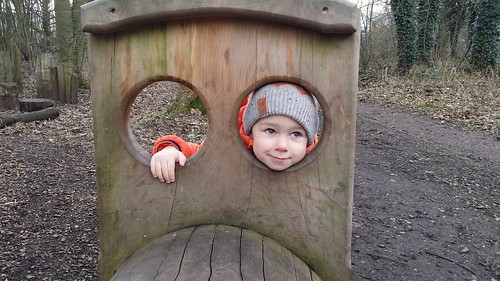
I wasn't actually present when this picture was taken. Steve took Jamie for a Daddy Outing to Foundry Wood, which is one of those rare places where I really wish I could go (it's a lovely outdoors natural environment community project with an interesting activities program), physically cannot go (there's only one entrance and that is a steep dirt track way beyond the capabilities of either wheelchair), and yet I can make my peace with the inaccessibility (natural environment, etc) as long as someone ensures that Jamie isn't missing out.

Also, not to put too fine a point on it, while I'm trying to soak up and enjoy all of Jamie's childhood it is also good for me to have a couple of hours OFF every now and again.

Anyway, Jamie and Daddy both loved it. They came home and showed me dozens of pictures of an absolutely idyllic time discovering all manner of interesting things. Choosing just one was difficult but I do love Jamie's happy little face in this one.

Saturday, April 08, 2017

13/52 2017

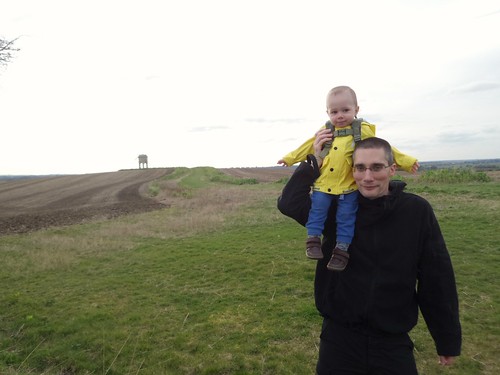
Daddy and Jamie, going on a little adventure. We live not too far from Chesterton Windmill, and for years it's been a place Steve likes to go and take pictures. I can't get up there - impossible to walk and rather too off-road for my wheels - but with Jamie in his bright yellow raincoat, it's easy to spot them while I wait with the car.

Daddy and Jamie at the windmill

Jamie enjoys sitting in the parrot position but I think he impressed Steve with how much of the distance he was able to walk. The biggest problem is convincing him to stay on the path!

Sunday, February 26, 2017

08/52 2017

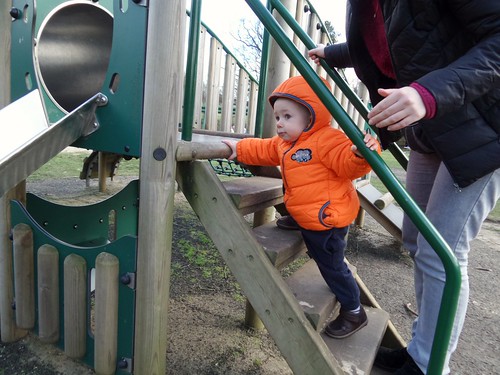
At the park again, and making better and better use of the equipment. Jamie is really getting the hang of climbing, although he's still somewhat overwhelmed by bigger kids. Having my PA able to hover behind Jamie on my behalf is a boon though. I do my best to be alongside, but playgrounds aren't perfect surfaces and I can't always get as close as I'd like.

Climbing

Sunday, April 17, 2016

On Practicalities

In the comments a couple of weeks ago was the following query:

"I wondered if sometime you might be able to write something about some of the practical issues around looking after a baby when you're disabled? My wife and I are considering having children soon, but I'm a bit concerned about how I will actually manage a baby with my level of fatigue (I have the same diagnosis as you), and with a wheelchair (how do you even push a pram with a wheelchair?!)."

I really want to answer this, but where to even begin...

Specific questions are easier and the query about pushing a pram with a wheelchair is simple enough to answer. I don't.

Every so often someone will send me a link to a product (which invariably turns out to not be a commercially available product, but a student's one-off engineering project or similar where they're trying to boost their grade on the Helping Those Less Fortunate ticket) that's a sort of pushchair that clamps onto a wheelchair. It's an interesting idea, but I've yet to see one that looks practical for any kind of day to day use.

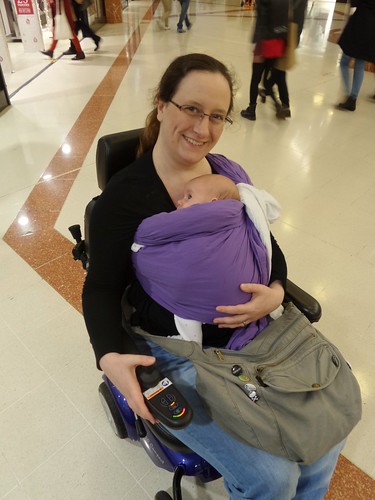
If we're somewhere like my GP's surgery, where there's parking directly outside, seats inside, and not a lot of walking required, then I walk leaning on the pushchair, but most of the time when I'm out and about with Jamie he's in a sling on my front.

Jamie in sling

To find out about slings, I googled for my local sling library. The lady who ran it was very welcoming, and we had a very useful consultation session trying on different kinds of sling with a doll, and then with Jamie himself. We considered my ability to put the sling on myself, as well as what it was like once it was on. Then I was able to borrow my preferred type of sling for a fortnight to see how it worked for me "in the real world".

The answer is, it works very well. The time it takes me to sit in the back of the car, fish Jamie out of his car seat, shuffle him into the sling, and be ready to go, is about the same time as it takes Steve or my PA to pull out the ramps and get my powerchair out of the boot and round to the side of the car.

He likes being in the sling, especially while we're moving, and often falls asleep in it. Staff at my local Sainsburys have been known to dash over to say hello to Awake Jamie when we've only just entered the store, because he's almost always dozed off by the time we reach the checkouts.

It was also quite useful at home while Jamie was smaller and sleepier, because it meant he could snooze while upright (reflux issues meant he wasn't always a fan of lying down, especially straight after a feed) and I could use the computer, which among other things allowed me to keep on top of the admin of my Direct Payments.

Drawbacks: reduced upper body mobility is the biggie. I still have use of my arms but not as much reach, and twisting around in the chair to get at stuff in the backpack is right out.

Eating and drinking with a baby strapped to your front can be tricky at best and potentially dangerous at worst. My experience so far is that while the baby is pre-high-chair, you either need to have a pram/pushchair to put him in, or you need to be with someone who's happy to take turns for who gets to eat vs who holds the baby.

It can get a bit heavy after a while. It's very inconvenient if you've gone out intending to try clothes on. And personally, I haven't felt comfortable to try going to the loo while wearing him. So if I'm going to be out for a long time, or as above if I'm planning to try on clothes or stop for food, then I ask my PA to bring the pushchair (which is also useful for stashing shopping). It's really important to me, though, that as a rule we don't have a PA pushing Jamie while Mummy trundles off ahead or behind.

Hopefully this helps someone... more questions welcomed, although I can't guarantee they'll be answered!

Sunday, December 13, 2015

Caesarean

Jamie was born by planned caesarean.

It was an odd decision to try to make. My condition isn't such that the medical professionals involved were insisting that a c-section was the only way to go, but the option was on the table from the outset. The decision, however, was entirely down to me, which helped me feel a lot more in control of things.

Surgery is never something to take lightly. As operations go, c-sections are pretty safe, but they ultimately involve a slice through your abdomen big enough to haul out an entire wriggling baby - there's a lot of risks to be considered and it typically takes longer to recover from than a complication-free "natural" childbirth. But we felt that, for me and my body and what I know of my condition for the last decade, an attempt at "natural" labour would be likely to end up in an unplanned c-section anyway, that would happen while I was exhausted to the point of incoherence - and then I would have to recover from surgery AND labour simultaneously, instead of one or the other. Therefore the best way of ensuring things went smoothly, that I recovered as soon as possible, that I understood what was happening and was mentally present for the birth of my child, was a planned c-section.

A secondary factor was that if I attempted "natural" birth and failed, that failure would be very upsetting. I would feel that I'd let the baby down. If I'd been so exhausted that I couldn't understand what was happening when I went into theatre, then my consent would have been a fuzzy issue, and I would feel like my hoped-for "birth experience" had been taken from me. It seemed more emotionally sensible to set my expectations at an achievable level.

I have to admit that even now, two months post-partum, I'm still not entirely reconciled to the c-section on the emotional side of things. There is so much information out there about the many and varied reasons why a "natural" birth is better for both mother and child, if there are no other factors to be taken into consideration, but pretty much all the information leaves out that caveat. Pregnancy magazines cheerlead expectant mothers along with soundbites like "having a baby is what your body was designed to do!" and (quite apart from the feminist and anti-creationism problems I have with that statement) this approach really excludes those of us whose bodies struggle with certain things. Every magazine I read gave me exactly the same feeling of "this isn't for you; you're not our target audience and we'd rather not have to consider you" as a shop or service building that has steps out the front. Goodness knows what it does to women who need c-sections but aren't already used to finding themselves outside the dominant paradigm.

Anyway. A planned c-section it was. The planning extended to the date, but not the time of the surgery. The way our hospital runs it is: people scheduled for c-sections that day arrive at the labour ward at 8am, and then the day's theatre schedule is created in order of priority, to include the women who are already in labour and for some reason need or are likely to need an unplanned c-section. I think this is a really good way of organising it. Not only does it mean that the women most in need are prioritised, but also, it was nice having some unknown elements in what was quite a medicalised version of having a baby.

On the day, we turned up at 8am and I was given a theatre gown straight away and told there were only two of us in for surgery that day so we'd likely be meeting our baby quite soon. Unfortunately emergencies started to happen and after a while our midwife came back and told us to get my socks back on and bundle me up in our coats to keep warm during the delay.

A while after that we were moved to the post-natal ward to wait. It had been agreed ahead of time that the best way to deal with my mobility needs after the birth was to place me in one of the side rooms, which had solid walls rather than curtains and a bit more space either side of the bed than the cubicles on the ward. I think perhaps part of the reason we were moved was to make sure that the room the ward manager had felt would be most suitable didn't end up being reassigned to one of the emergency cases. It was a lovely and unexpected bonus to get the chance to relax and acclimatise to the post-natal environment while still being pre-natal. I think the only downside was that being pre-surgery I had to keep declining the offers of breakfast, tea, elevenses, lunch, more tea... Mostly we were just being thankful that we weren't an emergency.

I did have to send Steve to go and eat something. He'd been too nervous to eat first thing in the morning. By mid-morning he was hungry, but didn't dare go to the cafeteria in case we were called for theatre while he was gone. Eventually around lunchtime I convinced him that I'd rather have him be two minutes late into theatre, than risk him passing out while I was lying there immobilised on the operating table.

And then suddenly, mid-afternoon, our midwife appeared in the room wearing scrubs and asked if we were ready? We took the coats and jumpers off me, I got into my wheelchair, and we followed her to the corridor where the operating theatre was. At that point, Steve was directed to go put some scrubs on, and I went into the theatre. There were windows and natural light as well as the electric lighting, which I hadn't expected but quite liked. I was in my chair right up to the operating table.

First I had to sit on the table to have the spinal anaesthetic. The anaesthetist(?), who I think was called Scott, stood behind me, while another person (doctor? nurse? other? I think his name was Trevor, everyone introduced themselves to me by first names rather than titles) supported me to try and bend forward enough that the needle could go in between the correct vertebrae. This didn't work so well - I think my back muscles had tensed from sitting in slightly awkward positions and also from being suddenly cold, plus of course I had a massive baby bump to try and bend around. Another person joined in, and the combination of being manhandled, but so very carefully, and at such an emotional moment, meant it was a weird halfway point between wrestling and a group hug. Eventually the spinal was in, though, and I lay down on the table and realised that I had, after all, forgotten to take my socks off.

At that point Steve was allowed in, although his first job was to return my wheelchair (and, I presume, my socks) to the post-natal ward. It can't have taken him more than two minutes but it felt like a very long two minutes. Meanwhile, probably-Scott was adjusting my drip based on what I was telling him. I did feel a bit silly and complain-y saying things like "I feel cold," and "I don't think I'll throw up but I feel a bit nauseous," but since his response was invariably "okay, we'll take care of that," followed by whatever it was being resolved, I guess it's what I was supposed to tell him. Finally a can of spray was squirted first at my arm (where I felt it as freezing cold) and then all over the rest of my body (where I didn't feel it at all), and we were ready to go.

Steve came back in and was told to sit at my right shoulder, and probably-Scott was at my left shoulder. There was a sheet suspended over my chest, and everyone else was on the other side of the sheet. The people in the room did do a quick run-through of names and roles but my mind was otherwise occupied.

I did not feel the incision, but I could feel the baby still moving inside me, and I could feel that my lower body was being moved about, although I have no idea what position I ended up in. It's not exactly a delicate operation and there was a whole lot of pushing and tugging - sometimes enough that my upper body on "our" side of the sheet was visibly moving. There wasn't any pain at all, but having the rummaging-about sensations meant I didn't feel detached from what was happening. Steve kept talking to me, and I kept breathing and trying to relax, and then there was the sound of a baby crying, which seemed so... scripted? clichéd? but of course it's what happened, and then someone said "oh, he's gorgeous!" followed by "erm, did they know if it was a boy or a girl?" which Steve and I couldn't help laughing about.

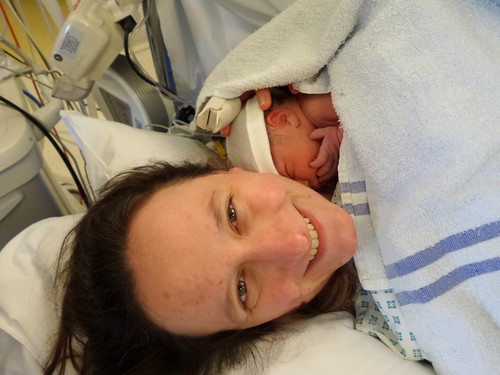
Steve took pictures with my phone of Jamie being wiped off, weighed, en-nappied and wrapped in warm towels. Then as per our birth plan, he took the first cuddle while the various wires and monitors around my chest were moved to allow Jamie to be placed on my chest for skin-to-skin contact. Probably-Trevor came round the sheet and joined probably-Scott for this bit but I really wasn't paying attention to anything at that point except Jamie, who didn't yet have a name. He was just Baby, all tiny and warm and fragile. He looked so very much like a complete and individual person that I could hardly believe that just a few minutes previously he'd been inside me, effectively one of my internal organs, growing out of the things I ate. I was aware, on some level, that the operation was still continuing, but I couldn't feel a thing any more. We kept cuddling all the while that I was being sewn back up, and he even stayed on me while the two of us were transferred from the operating table to a hospital bed and wheeled through to the recovery room, where the midwife helped us with our first attempt at breastfeeding.

It was a lovely birth experience. I don't have a Natural Childbirth Top Trumps card (hours in labour, number of stitches, etc) but in many ways that's a relief. I just have the care and friendliness of the NHS helping us transition to being a family of three with a minimum amount of drama.

Wednesday, November 11, 2015

Introducing Jamie

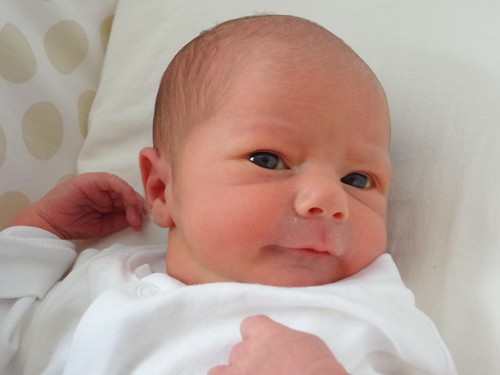
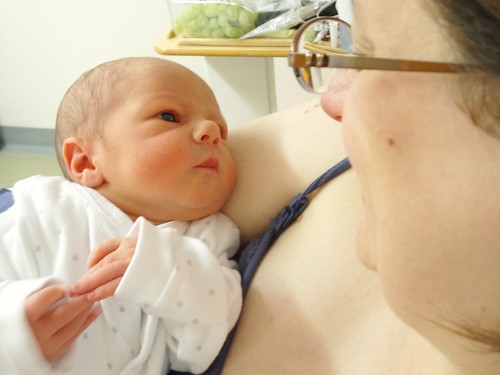
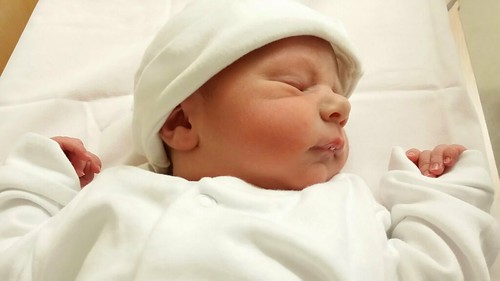
As planned, the bump was delivered to babyhood in mid-October. Internet, meet Jamie.

Big blue eyes

Born weighing 7lbs, he's healthy and happy. And perfect. Of course he's perfect. He has perfect ears and perfect long little toes and perfect enormous blue eyes. I want to write paragraphs and paragraphs about how brilliant he is in every way, and of course I don't have time, because he's a newborn, and I'm breastfeeding, and there's any number of friends and relatives to wrangle, and Steve's back at work, and babies make a lot of laundry... and honestly because for the last few weeks, if you gave me a choice between writing a blog post about my tiny baby Jamie, or actually cuddling him or playing with him or doing things he needs me to do, well, it's a no-brainer.

Serious concentration

There's difficult times as well. Like when he decides to wake up and demand feeding NOW NOW NOW in the same minute as I've got my dinner on the table. Like when he projectile vomits all over the place at 3am. Like when I haven't felt able to take my pain relief because it makes me too drowsy to take care of him properly and I'm not managing to fully let go and trust anyone else to be the Awake Responsible Adult who will make sure I don't nod off mid-feed and suffocate him (particular fear, there).

But these are vastly outweighed by the good bits. In some ways, even the difficult bits are good. One of our friends watched me calmly dealing with an incident involving a variety of bodily fluids and observed that he'd rarely seen me so happy. I am happy. I'm happy because I know I'm good with babies, I'm confident about what I'm doing, I'm well supported by Steve and by my friends, and everything is going well.
Official birth day portrait

What else to tell you...

The birth was by planned caesarean, which went well. We cannot praise the NHS staff enough - from the first booking appointment with the midwife at 10 weeks pregnant, to the theatre team, to the still ongoing postnatal care from the Health Visitor, everyone we've dealt with was professional and supportive. A particular mention has to go to everyone at Swan Ward at Warwick Hospital, from the lady with the tea trolley to the ward manager, they were compassionate and friendly and helpful. We thanked them all profusely and heard in response a lot of variations on a theme of "well, that's my job..." no. There's ways and ways of doing your job. Steve and I feel like we got absolute gold standard care, and never doubted that the three of us were safe.

never been so happy!

Lovely though everyone was at the hospital, it was still a hospital so I was very glad to be discharged just 50 hours after surgery. Steve had a full two weeks of paternity leave, which we definitely needed. We went out several times, and since he's gone back to work, Jamie and I have continued to go out with PA support. Every time we leave the house Jamie seems to make new friends - in supermarkets, in cafes, in the library, in the park, always there are strangers marvelling at him. It's making me feel better to be out and about after so much of my pregnancy was spent confined to base.

Intersection

The PA support is working out well. The golden rule is that the PAs Must Not Do Childcare. They must not, to give a specific example, change a nappy. But they can and do lift the baby onto the change table; if I have a moment and need to stop mid-change they can hold onto him and make sure he doesn't roll off while I pull myself together; and at the end of a shift they go through my "replenish list" to make sure that there are enough nappies (and cotton wool and wipes and cream and a fresh outfit and a few other bits and bobs) in various strategic locations within my reach to see me through until Steve gets home or the next shift starts.

Every day, I feel glad we did this, pleased with how it is going so far, and hopeful about the future of our little family.

Happy at home

Saturday, September 26, 2015

Phew!

Excellent news this week - Social Services have managed to put a care package in place for me as I transition to parenthood.

The remaining three weeks of pregnancy (plus the two weeks of Steve's paternity leave) there's not really any notable change from my existing care package. My understanding is that they are taking the view that if I've survived pregnancy for 36 weeks on my existing arrangement I will survive the rest.

I disagree with this. I have been horribly isolated and largely housebound during my pregnancy, because I've had to abandon my former activities as I've needed to use up so many of my hours on support for/transport to medical and social services appointments and trying to get the baby essentials in place. We've been extremely lucky in that I haven't had the sort of complications that lead to weekly appointments or all-day clinics. I've also been unable to participate in a number of the recommended activities that I had been hoping to engage with during pregnancy, such as swimming/aquanatal, antenatal exercise/social groups, shopping events that offer discounts on baby equipment, etc.

Plus of course, in this final month, my body is drastically changed and the baby is getting noticeably bigger week by week. We took 30 weeks to get to 3lbs, but only another 4 weeks to get from there to 4.5lbs, and by 39 weeks we should be between 6 and 8lbs. I'm huge! I can't lie on my front or my back any more! I don't dare lie down on the sofa while I'm alone in the house because I can't get back up! I need to wee all the time and I haven't got my stairlift yet! There's not enough room in my belly to eat a proper main meal, I'm supposed to be eating several smaller ones throughout the day but I don't have support to do that! If pregnancy is a marathon, the last bit of it is seriously uphill compared to the previous months!

The failure/refusal of social services to properly support my needs during pregnancy has caused a loss of freedom and has had a documented impact on my mental health (as well as, to a less dramatic extent, my physical health), and that baby and I have "survived" has had more to do with luck and favours than any idea that my support package has been adequate.

However, I have a choice. I can spend the next three weeks struggling to cope AND struggling to fight with social services for resources which, even if I technically win, won't possibly be in place before the birth. Alternatively, I can spend the next three weeks struggling to cope AND trying to focus on thinking the happiest thoughts I can, resting as much as possible, and trying to be ready for what happens once the baby arrives.

And this is the really good news. Once the baby is outside me and Steve has gone back to work, social services have granted me 40 hours per week of support.

It doesn't mean I'll have someone here all the time - Steve works more than 40 hours each week and there's commuting time as well. But if I structure it as two shifts totalling 8 hours a day, 5 days a week, and if I'm careful about making sure that at the end of each PA shift baby and I are safely set up with everything we'll need in the next hour or so to hand, then it will work.

I can feel safe.

Of course it isn't indefinite. The plan is to review it every two weeks (I admit to wondering if this will be two calendar weeks, or a social services "two weeks") and to reduce the package as I recover from the surgery, baby gets the hang of feeding, the medical appointments peter out, a routine begins to develop.

But that's okay. I can go into surgery to have the baby knowing that, at least while the stitches are in, someone will be around to help me fulfil my role as a parent. The first month, which I anticipate as being the most difficult, I will be supported.

I had been so scared that they were going to wait until an actual crisis occurred, that either the baby or I would have to be hospitalised to "prove" that we needed help before any help would be forthcoming. Or, perhaps worse, that the baby and toddler years would be like the pregnancy - baby and I would be trapped at home struggling to do anything more than survive, but that with luck and favours and Steve turning himself inside out we'd scrape along *just* well enough that no red flags would be raised, leading to a situation that never improved and a child who started school with all sorts of disadvantages because I had never been supported to provide them with proper pre-school education, socialisation, nutrition, exercise...

Instead, I have a chance. I *will* be adequately supported for that first month and probably for the second month as well. If I can use that time to engage with the Health Visitors, if I can develop attendance at the breastfeeding groups and other baby activities, if I can demonstrate that I'm eating well, if I can line classes and activities up for 2016, then I will be in a strong position to argue that I need to continue with those things to fulfil my parenting role.

Monday, September 21, 2015

An Update

In my last few posts, I talked about three major obstacles to the baby preparations.

One was the difficulties of getting assessed for a suitable wheelchair. After my last post, a number of people gave me details of companies and charities who had been useful to them. Sadly when I followed up these leads, some weren't able to help, and others were unhelpful by choice, showing me the chairs they wanted to sell rather than the chairs that would meet my needs, and calling it an assessment.

Thankfully, this turned out to be the easiest situation to resolve. The experiences with the "assessors" convinced me that I might as well ditch my fear that going into a mobility showroom would leave me prey to unscrupulous salespeople. I called a local showroom, explained my needs, and arranged an appointment. When I arrived, the salesman had several chairs lined up that did meet my specifications. After a bit more discussion and measuring, I was having a test ride, which included seeing if my favourite one would fit in the car. It did. The salesman then encouraged us to take our time, go home, have a think, and phone him on Monday if we wanted to buy it... and a brand-new one was delivered by him to our house at the end of that week.

I'm gradually getting used to it and I think it's going to meet my needs well.

There was Social Services, where "my" social worker had gone off sick less than three months into my pregnancy. The refusal of Warwickshire Social Services to transfer my case to a different social worker "because she'll be back soon" meant that I had no support at all until my pregnancy was past the half-way point, at which stage it was conceded that the Duty Social Worker team could help out with my case if they had time. I saw a Duty Social Worker at 26 weeks pregnant, but at the time of my last post, I wasn't confident that it had gone well.

At 32 weeks and with my assessment still waiting to be seen by the decision makers, my Health Visitor decided to see if she could intervene in any way. She was told that "my" original social worker was due back in the office any day and would definitely call her back as a matter of urgency. Except of course that this was every bit as much a lie as it had been every time I'd been fobbed off with it during the Spring.

Then at 33 weeks pregnant, for reasons it's probably best not to speculate on, I was officially reassigned to the proper caseload of the social worker who had been the Duty Social Worker who had seen me almost two months earlier. A few days later, I was given a date for my caesarean section which will be at about 39 weeks. I'm not sure if this deadline helped - at 35 weeks pregnant, with four weeks of pregnancy remaining, I think my assessment for additional support during pregnancy was very nearly ready to be submitted to the panel...

On the bright side, the Health Visitor and the no-longer-duty Social Worker are liaising directly now, and I think the midwife might be as well.

Which means I'm free to worry about the stairlift. At the time of my last post, after the delays caused by the absent social worker situation, we had sped through the assessment process thanks to a helpful and super-efficient OT and were awaiting a quote, which arrived, as it was supposed to, just before 28 weeks of pregnancy.

We signed, wrote a cheque for a deposit of over £2,000, and got it back to them next-day. According to the contract, this meant installation would happen within 6-8 weeks - so at the very latest, before 36 weeks of pregnancy (or "well before the end of September" for those of you who prefer a traditional calendar). It was cutting it fine, but it would be okay.

We were quite surprised to then be offered an installation date in the middle of October, or 39 weeks of pregnancy.

There were two problems with that.

One was that it was 3 weeks over the maximum 8 weeks promised in the contract, which really is not good enough when you are forking over five thousand pounds for essential equipment. I signed that contract on the understanding that my stairlift would be installed within the timeframe specified in the contract.

The other was that the date they were suggesting was the actual date for which my caesarean is booked.

After a lot of phone calls (which is always me phoning them, because their inability to stick to their own suggested timescales extends to calling back when they say they will), they have managed to rearrange for installation to happen in the first week of October. This is still breaching the contract - but I don't have the choice to make a big deal about that, because I need a stairlift in place before the baby gets here, and it is too late to get one from a different provider.

I am in my final month of pregnancy. I am supposed to be thinking nice, nurturing thoughts, and doing gentle exercises, and nesting. If I was at work and experiencing this kind of stress, I would be advised to start my maternity leave now. But there's no maternity leave from this situation.

Sunday, July 26, 2015

Wheelchairs

As most people who know me are aware, I currently have Alber E-Motion M15 power assisted wheels and I have loved them for every minute of the five years I've had them.

I was incredibly fortunate to get help from Access To Work in being assessed for and part-funding them, and even more fortunate that being self-employed and working from home I was permitted to use them as much as I needed to. They're not categorised as being for my personal/social/leisure use as the assessment was done purely with my work needs in mind, but at the same time, no one expected me to remain housebound/struggle to walk/submit to being pushed/use a badly-fitting generic non-powered wheelchair/etc when I have a properly-assessed-for power-assisted fitted wheelchair that is ideal for my needs sitting right there in my house.

Predictably enough, with pregnancy my wheelchair needs are changing. My wheelchair as fitted five years ago is becoming increasingly uncomfortable to sit in, and my stomach muscles are no longer strong enough to allow me a proper push, especially going uphill, and the increasing size of the bump means I can't lean forwards at all. Even on ideal terrain, such as the absolutely flat smooth surfaces in my local supermarket, I still have to stop and lean back when the baby decides to have an energetic wiggle.

I'm only going to get bigger for the next three months, and my stomach muscles are going to keep loosening and stretching, and then once the baby is born I want to wear a sling rather than trying to negotiate fixing a pram to a wheelchair (or worse, having a PA pushing my baby in a pram alongside parents with their babies in prams while I am baby-less, self-propelling and trying to pretend that I'm the one of us who belongs in the group of parents walking around the park with their babies), not to mention that it's going to become even more important to conserve my energy so that I can meet the baby's needs... I'm going to need a fully-powered wheelchair.

We knew this would be the case before we started trying to conceive, and as such we saved up to be able to purchase a fully powered wheelchair when the time came. My needs aren't especially high, my body is not particularly fragile or unusually proportioned, and of course I won't be sitting in the chair all day every day. But, with the baby in the mix, we don't want to buy something random and second-hand - we were always clear that we'd want it from a reputable source, covered by warranty, and with servicing available locally. The price range we were expecting was between £2,000 and £6,000.

One problem is that the unexpected £5,000 we already have to pay for the stairlift, plus a rent rise and a couple of other unexpected factors that aren't disability or baby related, has left us with rather a different financial picture than we'd imagined.

A bigger problem, though, is that I can't get an assessment - and am loath to just trundle into a random mobility supplies shop and ask a salesperson to assess me, in case what they decide I "need" turns out suspiciously close to what they will make the most commission on or are desperately trying to shift out of their stockroom.

The NHS Wheelchair Services position is that powered wheelchairs are only prescribed for people who need a wheelchair to move around their own home. This is obviously not the case for me. They also can't prescribe a self-propel wheelchair to someone who can't self-propel, and attendant wheelchairs are somewhat dependent on *having* an attendant.

This issue couldn't be tackled ahead of pregnancy because resources are quite in-demand enough for situations which already exist, without being done pre-emptively for situations which only "might" occur such as conception of a baby. But my GP and midwife have, since week 10 of this pregnancy, tried every route they can think of, up to and including obtaining the Wheelchair Services referral form and then writing all over it that while we know WS won't fund or prescribe a powered chair for me, maybe they could just *see* me and *advise* on what sort of chair I should be privately purchasing... nothing. The most useful response we've had is "well, whoever assessed for her last chair can assess her again," except of course that was Access To Work and even if they hadn't been hideously defunded in the last five years, my non-work needs for late pregnancy and early parenthood are not their remit.

The Social Services OT also tried, but again, all roads lead back to NHS Wheelchair Services, who refuse to so much as see me.

Following a Twitter conversation with a friend, Scope tweeted to me that I could try the Mobility Trust. I've written to them, but have not yet heard back and I believe from the information on their website that they are more about helping people who already *have* assessments out of the funding hole, rather than helping people get assessed in the first place. Steve and I know that despite our current financial upheaval and zero assets, we're still relatively privileged in that we have an above-benefits-level income and zero debt, and as such probably don't come under the charity umbrella.

The best result I've been able to obtain is that one morning, after an hour or so chain-phoning this or that organisation, explaining the predicament, and being told "not our remit, you might want to try (person) at (organisation), their number is..." I actually got to *speak* to someone at the local Wheelchair Services. They still refused to help with an assessment, but they did give me the name of the supplier they usually use, and told me that they regarded that supplier as being a trustworthy and established local business who would assess my needs without a rampantly profiteering head on. It didn't quite work out that way. I made an appointment to go in and discuss my needs and was proudly handed a couple of PDF printouts from manufacturer's web pages, for incredibly expensive made-to-fit support-everything bespoke powerchairs. The salesman seemed to lose a bit of interest when I said that neither my needs nor my budget were quite that high, although he did offer to get one or two powerchairs in and then call me so that I could test them. This is not the same as discussing my needs and preferences and figuring out which of the chairs on the market might best suit me and then getting *that* powerchair in for me to try. It's fine as a fall-back option, but this is an investment of thousands of pounds of our own money, we'd really quite like a few more options and a little bit of guidance!

Part 1 Part 2

Stairlift

I've been supposed to have a stairlift for quite some time now. But what with the insecurity of living in a rented house, and sharing that house with a non-disabled person who likes to run up and down the stairs unimpeded, we never went ahead with it. I carried on going up stairs on all fours, coming down stairs on my bum, and sitting halfway up/down the stairs having a little rest when necessary. It was okay. I'm under 35 and not exactly frail, I've got solid young bones and plenty of padding on them. When I fall down the stairs, so far nothing worse has happened than some cuts, bruises, grazes and/or carpet burn, maybe a bit of damaged clothing, and whatever I was carrying taking a brief flying lesson.

As you can imagine, being pregnant - having a baby on the inside for now and knowing that once the baby is on the outside I still need to get both of us up and down the stairs safely - changes the goalposts somewhat. All of a sudden I'm a lot less flippant about falls. On top of which, as my bump gets bigger, it becomes physically more awkward (and eventually will be full-on impossible) for me to go up on hands and knees or rest halfway if I need to. Steve and I agreed that pregnancy would make us concede to the stairlift.

(At this point well-meaning people tend to sagely advise us that we should move house to a bungalow. Leaving aside the implied insult that we are too stupid to have thought of such a thing, the trouble with bungalows becomes apparent when you try to actually *get* one. Social housing bungalows are too small, privately rented bungalows are too expensive, purchasing a bungalow is out of our reach, and all types of bungalow are very rare. We do search occasionally, but in every category those few that come up and look like they might meet our needs tend to, on further investigation, be on special zones or estates that exclude us with rules stating they are only available to over-55s or that children are not permitted.)

The delays and difficulties with Social Services meant that I was 21 weeks pregnant before the Housing OT Gatekeeper phoned me - and promptly advised that a stairlift would take at least six months to sort out, which isn't a useful answer to someone who needs to be baby-ready in four months. Happily I was able to persuade her to refer it upwards, with the result that she phoned me the next morning and I got an appointment to see the OT at 23 weeks.

The OT was lovely, as OTs tend to be. Along with various other things, including a referral to a specialist OT service for disabled parents elsewhere in the country, she agreed that a stairlift was required ASAP, and since it was therefore a prescribed item rather than a personal choice, gave us a financial assessment form.

Financial assessments are conducted differently by different departments. They all have different criteria. For example, at present, I'm not eligible for welfare because as a household we have earned income - but I don't have to pay for my basic care package because that is calculated on savings, investments, assets, property, trust funds, etc, with our earned income from our current work being disregarded. For a Disabled Facilities Grant, which is what would normally pay for a stairlift... everyone had assumed that we'd be eligible, but it turns out we're not eligible due to Steve's earnings.

Which means we (meaning he) will have to fund the stairlift privately.

Which will be about £5,000.

There's no choice though. We don't have a downstairs loo and there's nowhere we could put a commode downstairs, therefore if we want me to be able to use the loo with hygiene and privacy, which in the UK is considered a pretty fundamental necessity for anyone, let alone a pregnant woman or new mother, we need a stairlift.

At 26 weeks the OT came back with a couple of engineers in tow to measure things and pull faces, and the proper final itemised quote should be with us by 28 weeks.

They tell me there's then a 6-8 week wait after I get the quote, confirm the order and stump up the deposit before work can start. The particular parts for my particular measurements and prescription need to be shipped in and then of course the relevant engineers must be booked. That will bring us to 36 weeks or as near full-term as makes no difference, or to put it another way, I might end up using a bucket in the lounge after all, or trying to find the money to allow me to spend what should be the "nesting" period in an accessible hotel room. I guess the best case scenario is that if I go into early labour, they might not be able to release me and baby from hospital until the house is habitable.

That the delays and heel-dragging of social services in the first half of my pregnancy has resulted in my basic predictable needs for the final stages being cut this fine makes me even more upset than the money aspect.

Part 1 Part 3

Not 24 weeks

I don't know if anyone was watching closely enough to notice, but there has been no 24 week update, and there is also no 24 week picture, and now I am just over 27 weeks pregnant.

This is largely because there's been just too much other stuff to deal with. All three of us are healthy (usual parameters), no emergencies, just... Stuff.

The first bit of the Stuff is Social Services.

This was very much a planned baby, and part of the planning was getting input from Social Services before trying to conceive. I'm pleased to say that we got a good, positive response. We were reassured that we had an absolute right to a family life, and that Social Services would support us to meet not just basic survival needs, but also to fulfil my role as a parent. The child is not automatically considered "at risk" and if I struggled to meet the child's needs then before Child Social Services would even consider getting involved, Adult Social Services would need to have done everything possible to enable me to look after the child myself. Specifically I was told that instead of my case remaining effectively "closed" (as it is while a person is stable and their needs are being met by their existing care package), once I informed them of a pregnancy I would be on the active caseload of a named Social Worker, they would review me every three months during pregnancy and the first year of the baby's life, or more frequently if necessary, and as such my care package could be altered according to the rapidly changing circumstances.

That filled us with confidence and we went ahead. Spool forward to Spring 2015. Eight weeks pregnant, I met "my" social worker, and we got on well. She was every bit as positive. We decided that she would line up all the various referrals to Occupational Therapy and Independent Living and so on, but given my history we would wait until my 12-week scan before forging ahead, to save on upsetting encounters if anything went wrong.

So, after my 12-week (actually 13 and a bit) scan, I phoned her office... was told she was off sick but would be in touch when she got back the next week. Nothing happened. Phoned again at 17 weeks... was told she was off sick but would be back the next week. Nothing happened. Phoned again at 19 weeks... was told she was off sick and they didn't know when she would be back. I pointed out that the baby was not going to wait indefinitely until "my" social worker was back and asked if I could be transferred to someone else's caseload. The answer was no, but that a Duty Social Worker would call me back.

(Duty Social Workers are to named social workers as duty GPs are to named GPs. They're fully qualified, and authorised to open and read confidential client files and take necessary action. But they're supposed to deal with that day's emergencies and situations requiring an immediate response, not ongoing or future care requiring familiarity with the case or time for research about a specialist situation - and they prioritise their time, so if you *can* wait until tomorrow, the chances are you will.)

Nothing happened. At 21 weeks, I phoned again and explained that pregnancy is only supposed to last 40 weeks, so the baby was more than half-way here, I was having increasing difficulty doing things and that while I appreciated I wasn't an absolute emergency, I really quite urgently needed to hear from a social worker if we were going to avoid me AND the baby becoming one.

Finally, two days after that, a Duty Social Worker called me. He'd opened my file; he'd seen that "my" social worker had been intending to start off a number of referrals as soon as I'd had my 12-week scan but that she'd gone off sick before this could happen; he agreed to authorise and send off those referrals, marked as Urgent in an effort to catch up to where we should be. However, "my" social worker was expected back within a couple of weeks, so they couldn't transfer me to anyone else's caseload or conduct a reassessment.

I was really pleased that things were moving at last, but of course that was when the challenges really started. Because I had no social worker to oversee things or fight my corner, I had to try and comprehend the whole system myself. First getting past gatekeepers, then being referred on to yet more people or organisations, and trying to keep track and make sense of who everyone is, when I see them, what their remits are... I'll go into more detail in another post.

At 22 weeks, someone from Independent Living saw me and agreed to formally refer me to be reassessed by a social worker. At 23 weeks, she phoned me back and told me that the referral had been postponed because they wouldn't transfer me to another caseload, because "my" social worker was off sick but would be back in two weeks. Does this sound familiar? Can you guess what happened? That's right, two weeks later (25 weeks) I was told that "my" social worker was still off sick! But, obviously, they couldn't transfer me to someone else's caseload, because she would likely be back in two weeks!

*headdesk* *headdesk* *headdesk*

Thankfully by this point my list of "two weeks" was long enough that it was conceded I could be reassessed the following week by a Duty Social Worker for my third trimester needs. Her findings would be submitted to a panel who would decide what help I would get.

I honestly felt sorry for that Duty Social Worker. I think like many social workers she went into the profession wanting to make things better for people, but... she was visibly stressed and very disillusioned. I had prepared notes ahead of the meeting with an outline of the sort of bare-minimum support I felt I would need. The moment that has stayed with me is the moment when she sighed and said "I don't think you'll get this. Do you really want me to ask?"

Outwardly I replied that yes, I wanted her to ask, because if she didn't ask, then I definitely wouldn't get it!

Inwardly I curled up in a terrified ball. At 26 weeks, the baby was already wiggling so much that the movements could be felt from the outside, and if anything went wrong, there would be a chance of both of us surviving it. There is no turning back. I'd only started on this journey after getting reassurance that it would be okay - I thought I had been as responsible as possible in ensuring that if I ever did have a child I would be able to provide a decent level of parenting. And now here was a social worker who, in contrast to the positivity of those I saw pre-conception and at 8 weeks, was so doubtful about the likelihood of me getting support that she didn't even want to ask the panel for it.

She also let us know that it would be at least a week before she got the chance to type up the reassessment. In an effort to do something positive, I offered to send her my notes to save her some typing time. Then, before sending them, I spent a couple of days going through them, being rather more specific about the help I need, why I need it, what the risk factors are if I do not have that help, how I am currently struggling/failing to meet this or that criteria because of lack of help. But it is not a positive experience to spend days thinking intensively about the things you will struggle or outright fail to do for your child due to lack of resources that you reasonably believed you would have.

The only other positive I can draw from that meeting is that the Duty Social Worker didn't seem to disagree that I would need the help I said I would. She just feels that with austerity, social workers' requests get turned down more than they might have done a couple of years ago, and she doesn't like it when the panel say "no" to her.

At this stage, there's not much I can do about Social Services other than hope that the Duty Social Worker manages to persuade herself to present my case, and that the panel respond favourably to the information. It will be at least another couple of weeks of hoping before I hear back.

Meanwhile, there's still more than enough to keep me occupied with stairlifts and wheelchairs...

Friday, May 08, 2015

Testing

The other day I blogged about my private scan, and the joy of it, but also my misgivings about the way private healthcare uses fearmongering to boost profits - in this instance, by telling pregnant women that "time was running out" for them to get tests not routinely offered by the NHS.

These misgivings are reinforced when I'm on forums with parents-to-be from other countries who are dependent on less-than-stellar private healthcare packages and are having to approach all tests from a position of "can we afford it?"

So I feel wonderfully lucky to have the NHS, offering testing and screening and scanning and measuring for all sorts of things. Obviously (I hope obviously) I'm entirely against the idea of aborting a foetus for having a disability. On the other hand, I think it's a damn good idea to know if there's a treatable medical issue endangering the life of the mother or the baby. On the other other hand, screening tests are imperfect (screening determines only likely/unlikely, secondary testing is required to obtain a yes/no) and being told your pregnancy is "high risk" for something can cause a great deal of often-unnecessary worry. On the other other other hand, I can really see the logic of being able to research and prepare ahead of time for a baby which will have complex needs from birth...

It's an incredibly tangled and emotive issue, and one that it's very difficult to discuss without encountering distressing invective about disability, abortion, women's rights to make decision about their own bodies, shaming, blaming, name-calling and all sorts of other unsavouriness.


Weirdly, for me the decision has been made vastly simpler by being disabled. I know ahead of time that when I get past, say, week 38 of 40, I'm going to become difficult. At the absolute very minimum, once the baby is born and I'm on the ward, I'm going to need my wheelchair and/or walking frame beside the bed - and every disabled person reading knows that hospitals don't like you bringing your own (I think it's a philosophical problem as much as a space and hygiene issue). When I use that wheelchair or walking frame to get to the loo, I'm going to need the staff on the ward to understand that it's not appropriate to tell me that having had a baby doesn't make me disabled and to just walk properly. I may have to determine whether my PA counts as a visitor because while I'm wiped out I'll need advocacy. There's all sorts of stuff, none of it insurmountable, but all of it needing to be addressed.

So, up until the point at which I really really need to raise my head above the parapet and start being (what I fear will be construed as) fussy and awkward, I feel I should be as compliant as possible with the non-invasive testing. Build up my credit, sort of thing. For every single test, the accompanying leaflet reminds you that you have the right to refuse, but I feel that it will serve me better not to have "refused testing!!!" or worse, "has internet access" written on my notes, you know?

Friday, May 01, 2015

BADD 2015: Progress

Blogging Against Disablism Day, May 1st 2015

Written for Blogging Against Disablism Day 2015.

Years ago, I participated in BADD 2009 with this post about an offensive blog comment I had received. The commenter had noticed that, participating in a Bucket List style meme that was going around at the time, I'd mentioned that having a child was among the things I would like to do. She felt it her duty to inform me in no uncertain terms that it would be "cruel" of me to inflict my "seriously broken" self on a child and instructed me to "stay on birth control and accept (my) fate" of not being a parent.

It wasn't the first time I'd had to put up with that kind of garbage. In the earlier years of my illness, in an exchange I've never quite managed to get over, my sister had somewhat triumphantly told me that now I was sick I would "just have to give up" on my lifelong hope to one day have a family. When I made a slightly stunned effort to assert that disabled people could still have children and that as long as I secured the right support it would be possible, suggesting an au pair as just one potential option, my mother joined in with the marvellous line "why have kids if someone else is going to raise them?"

After having to deal with attitudes like that from my own family, I wasn't exactly going to be left devastated by a semi-anonymous blog commenter. On the contrary, having the attack coming from someone I didn't know meant that I finally had a chance to reply without worrying about the feelings of the person who'd just insulted me. But I was still a little bit concerned about what sort of response there might be, considering how BADD posts tend to get rather more exposure.

The support from the online disability community took my breath away. People were angry right along with me. Directly and indirectly, via comments and emails, parents shared their stories - not sugar-coated success stories or bitter tragedy ones, but real stories including the hard work AND the joys and achievements involved. The BADD archive, for every year since 2006, offered a category of posts on "parenting issues", both for disabled parents and for parents of a disabled child. Not to mention all the posts in other categories, written by disabled parents but not about parenting!

I felt more encouraged, rather than less. I learned about all sorts of little tricks, suggestions, ideas, and resources (although if anyone can suggest an active non-Facebook replacement for the sadly now defunct Disabled Parents Network, it'd be a help). I was able to access publications written for disabled parents telling me what sort of support I should be able to expect from Social Services, and how to go about accessing it. Sure enough, I spoke to Social Services and got written confirmation that I would be supported in my parenting role. I'm also pleased to say that having this more concrete grasp of what I'm doing appears to have enabled me to put my family's fears and prejudices to rest.

In October 2015 Steve and I are expecting that baby. We are confident. Our baby, our so very wanted baby, will arrive and will be loved and cared for, and part of that is due to the hope and practical help that BADD unlocks.

Monday, August 04, 2014

Ice cubes

We have the most *amazing* ice cube tray - cute and accessible.

Here's the manufacturer's website for the black + blum brrrrr ice cube tray, but I thought I'd take a picture that was a bit less stylish and a bit easier to link to, as well:

Ice bear!

So basically it's a wide-necked bottle that has ten blobs along one side. It's up to the beholder whether this makes it a ten-legged polar bear. The bear's black nose, aka the lid, just pops off, nice and easy, no gripping or twiddling required. There is a hole in the part of the bottle that makes the bear's "back". You hold the bottle upright (the shape makes it easy to hold) and pour in water (hurrah for the wide neck) until it starts to come out of this hole. That means you have the right amount of water. You pop the lid on again. Then you stand the bear, on its legs (or whatever), in the freezer, where the gravity does a much better job of distributing the water than I have ever managed with a dribbling tap or shaking jug.

Another thing which makes it much better than a traditional ice cube tray for me is that I don't have to try and balance it over to the freezer. As long as the bear's nose and back are facing more or less up, then water can't come out. It's very anti-spill.

Getting the ice cubes out is even better. No wet hands, freezing fingers, cracking the tray, fumbling to lever out one or two, failing and sending the whole trayful across the floor. You just hold the bear by the head and bang it against something until you hear the rattle of some pieces of ice coming loose. Then you pop off the nose again and pour them out. Yay icy bear vomit!

Tuesday, July 15, 2014

Coombe Country Park

This weekend Steve and I had a friend come to visit, and the three of us went to Coombe Country Park. It's very pretty and a really nice place to spend a sunny day. Entry is free, parking is the really quite reasonable sum of £1.90, and access is pretty good as these things go. It's "natural" paths rather than tarmac, so not the smoothest of rides, but in the dry weather the easy access route is very do-able and the medium access was what I would describe as bumpy, but possible with assistance.

I needed assistance three times.

The first time was to go over a bridge. The gradient of the slope up was just a little more than I could comfortably manage... I probably could have done it but there's no prizes for hurting yourself when you're with people who are entirely happy to give you a boost.

The second time was to go down a slope where the path had a deep rut all the way along the centre, presumably caused by a combination of feet, bikes, and from the look of it I suspect water when it rains. It was just a bit too wide for my chair to go astride it, and there wasn't quite enough space for me to go down one side of it - especially once nettles, tree roots, patches of loose pebbles, patches of loose sandy soil, etc got factored in. So Steve took my chair down and our friend took me, and we all made it safe and sound to the more solid path at the bottom of the hill.

The third time... the third time was the most terrifying, but was nothing to do with the park itself. It happened, of course, at about the furthest point of the two-mile medium access loop around the forest and conservation area. My left front wheel started making a funny noise. The funniness of noises is a bit subjective when you're talking about hauling a four-year-old cross-folding wheelchair along a forest track, but this was a really funny noise with more than a hint of ominousness. I looked down, and noticed that one of the two bolts holding the left front wheel unit on was sticking out by just over an inch. I put my brakes on, reached down, and caught the bolt as it came out completely and the whole wheel unit flopped.

Things got worse as I examined the bolt and saw it required an allen key. Although I had two pocket multitools with me, furnishing an assortment of screwdriver heads, cutting blades, bottle openers, tweezers, pliers, etc... the nearest allen key we knew of was in the car. Which was at least a mile away over terrain which in one direction was completely unknown and in the other direction would include going up the slope that I'd already needed help to get down.

I got out of the chair again and we all took a closer look to see how much of a field job could be done with the tools we had available. We hadn't lost any bits, and it seemed to have simply untwiddled itself rather than having sheared away or anything, so that was good. Unfortunately, Steve realised that lining up the bolt that had come out would mean undoing the second bolt as well to take the whole wheel unit right off, in order to align the whole thing properly for both bolts to go in together.

Being out and about, especially in nature-type places, always gives me a sort of thrill that people who've never been housebound don't quite get. Look at me, how daring I'm being, not only out of the house, but a mile or more away from the nearest car. Which is great until the point you're sitting on a dirt path, knowing that yes, that's right, you're an actual mile or more away from the nearest vehicle, and trying to stay calm while someone fully detaches a wheel from the object you depend on not just to get back to a place of safety but to move around independently once you're there.

Of course it could have been worse. There were three of us. It was a sunny, dry day with about eight hours until sunset. We were on an "official" path, we had phone signal, a picnic blanket, and plenty of water. I was hardly at risk of life or limb. I trust Steve, and I know that he has more mechanical ability than I do, and I know that he's read the manual, and I know he won't put me at unnecessary risk. I was happy to let him lead the repair effort, and he kept me informed and waited for my permission at each stage. Even so I was only one notch off a panic attack at the point the wheel was entirely removed.

Thankfully my faith was not misplaced. Within a few minutes Steve had got the wheel back on and we were able to move again, albeit somewhat cautiously and with all three of us continually peering at the chair every few minutes. The rest of the path was much kinder, and bit by bit we reached the visitor centre, got some lunch, and then I installed myself on the picnic blanket within not just sight but wobbling distance of the car.

On our return home, Steve tightened up every bolt he could find on the chair, using the Official Toolkit. Apparently most of them were pretty tight and the ones on the right front wheel were basically immovable, so we don't know why the left one managed to work loose.

The bad news is, now the car has started making a funny noise.

Thursday, May 01, 2014

BADD: Less hostility, please!

Blogging Against Disablism Day, May 1st 2014

Could everyone please stop glaring at the people who support me?

No, seriously, knock it off. The people who support me, which encompasses friends, family, and paid employees, are absolutely invaluable to me. They increase my quality of life more than I could ever describe.

Yet all too often, when we are out in public, they are subjected to tutting, glaring, and occasionally verbal abuse. They're sick of it. So I have to put myself in the way of it. I'm sick of having to do that.

The Battle Of The Blue Badge

We're out and about. We've parked, legally and legitimately, in an accessible parking spot for blue badge holders. My blue badge is correctly displayed.

Half an hour later, we're not going home yet, but one of us needs something we've left in the car - a jacket, an umbrella, a bottle of sun cream. Or maybe we've purchased something that's a bit too bulky to carry around all day that we want to lock in the car while we continue shopping.

Fatigue is a big part of my illness. An extra few hundred metres to the car and back can make a significant difference to me. Especially if to a person using the stairs it's only fifty metres. It should be possible for me to ask my non-disabled companion to nip back to the car while I use the opportunity to sit quietly for a few minutes and gather my spoons. That would be the sensible thing, right?

Instead, I end up going with them so that the visibility of my wheelchair provides a force field to protect them from the hostility of the self-appointed parking police who believe they can assess disability and determine legitimate blue badge use at a single glance.

No companion of mine has ever reported any trouble from an actual parking attendant.

Drive-By Training Sessions

Since I got the power-assisted wheels of awesomeness, I've really developed a taste for independent mobility. I know, these wacky concepts some people are into. The rule, therefore, is: unless I am losing consciousness, or I am oblivious to an imminent danger, or I have specifically requested that you do so, it is never okay to take hold of me or my wheelchair. It's pretty much the same rule that applies to physically grasping anyone to take control of their movement.

I can go up hills. I go more slowly than I do on the flat, but the wheels do the work. Sometimes passers-by ask me if I'd like any help, and - as long as they believe me when I say No Thank You - that's okay.

What's not okay is when they stare pointedly at my companion while saying "someone should be helping her," or worse, "you should be ashamed, letting her struggle like that."

On one occasion it got so bad that the friend who was with me asked for permission to just put their hands on the handles of my chair lest they be fried alive by the laser-beam eyeballs of a particularly indignant stranger. I refused - I will not reinforce the false prejudices of others by pretending to be more helpless than I am - and to my friend's credit, they respected my refusal.

It did impact the mood of the afternoon, though. If we'd been walking at that pace, no one would have batted an eyelid and we'd have been free to enjoy ourselves without intervention.

Dominion Of The Golden Throne

Yeah, you knew this was going to crop up. The accessible loo.

My companion waits outside while I'm doing what one does. The locks and indicators on the doors of accessible loos are notoriously unpredictable, so sometimes I'll ask them to let any other would-be widdlers wanting to go in know that it's occupied.

And this is the one where disabled people themselves are the prime offenders. From the other side of the door I hear them refusing to listen to my companion's explanation, barging past, rattling the handle, and launching into a rant about the facilities being for disabled people only - a statement which also includes a lot of assumptions about the "disability status" of my companion. On a less dramatic and more frequent level, there's the people who position themselves to block my exit from (and my companion's potential entry to) the cubicle. As a rule, they have the good grace to blush and get out of the way when they deduce from my wheelchair that oh, I am disabled, and maybe this person was just waiting for me, and oh gosh, what if I'd opened the door because I needed them to come help me, oops... but that doesn't help. It just makes me thankful that my wheelchair, as well as being a mobility aid, is a symbol. It makes me worry that one day when I'm walking with my stick, which has less symbolic impact, the situation won't be defused as efficiently. It makes me scared for the various people I know with leg or back impairments who can stand and walk quite well unaided but need a fixed handle to safely manage to sit down.

Situations like these make me upset that yet another everyday non-event has been turned into a battleground, and guilty that I have exposed my friend or employee to abuse, and powerless because I feel fairly certain it'll happen again.


Again and again, the barrier that is hardest to knock down is the attitudes of other people, and our own. Even when I have privileges like the blue badge, equipment like the wheels, accessible facilities like the loos, accessible environments with step-free ramped routes, and appropriate human support - the issue of disablist attitudes remains, and impacts negatively on me and on the people around me.

This is the barrier that Blogging Against Disablism seeks to overcome.


If you haven't already, please visit Diary Of A Goldfish to read more posts.

Sunday, April 27, 2014

BADD 2014

Blogging Against Disablism Day, May 1st 2014

The ninth annual Blogging Against Disablism day will be on Thursday, 1st May. This is the day where all around the world, disabled and non-disabled people blog about their experiences, observations and thoughts about disability discrimination (known as disablism or ableism). In this way, we hope to raise awareness of inequality, promote equality and celebrate the progress we've made.

Due to the overwhelming everythingness of last year, I didn't participate in BADD 2013. However, I loved taking part in 2008, 2009, 2010, 2011 and 2012. I'm thrilled that it's happening again in 2014.

BADD is not just for disabled people. If you feel like you have anything to say on the topic, then please go to Diary Of A Goldfish (Blogging Against Disablism Day) to sign up.

Tuesday, March 26, 2013

Cake (picture-heavy)

For reasons too complicated to explain, I found myself committed to baking a cake for a friend in another country who isn't going to be here to eat it any time soon. The only relevant part of the backstory is that I was meant to make a cake some months ago and made a bloody great mess on the floor instead. It's almost like I got DLA for a reason.

Nevertheless.

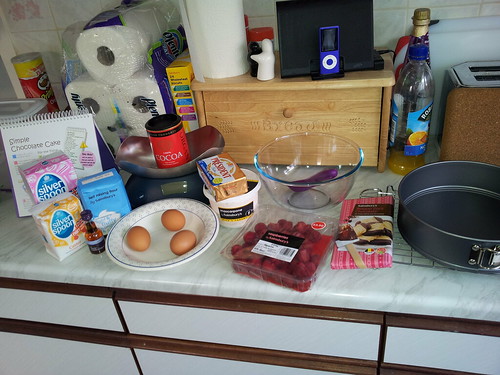
Part One was done in advance. I found a recipe, of the sort that tells the cook to get an adult to help them with the oven, and went and bought the stuff I'd need.
this bit i can do.
I think eggs and butter were the only things I had in the house anyway, and I didn't have enough of either, so I purchased the whole recipe. Using mostly supermarket-own-brand ingredients this came to about £15. Admittedly I have a lot of stuff left over - flour, sugar, icing sugar, vanilla essence - but I'm really unlikely to use any of it. Even if we just add up the things that were entirely used up it comes to over £8. It would definitely have been cheaper, in monetary terms, to just buy a cake.

Nevertheless, again. This is not about eating cake. This is about making a cake.

Greasing the cake tin wasn’t too traumatic. Measuring ingredients was a bit okay if a little messy at points. Creaming the butter and sugar brought me back to that whole "DLA for a reason" thing. But that's okay, because the difference between making a cake and cooking a meal is that I can take as long as I like to make a cake, and it doesn't matter if it's the only thing I do today (I will now stop banging on about DLA. I'm just always worried, when I post about my biannual adventures in cookery, that someone's going to try and use it to report me).

Adding the eggs to the butter and sugar was… well it started okay and then I thought it looked a bit lumpy, but no matter how much I stirred the lumps wouldn’t go away, so I figured, it’s butter, it’ll have to melt when it cooks if nothing else, and pressed on, adding a tidge of vanilla essence, a tidge of milk, and the sifted cocoa and self-raising flour.

The resulting dough was tasty… uh, did I say tasty? I meant it looked tasty. Yes. Looked. Having no great cake-making expertise I did wonder whether it was meant to be dough. If it was meant to be batter then I’d done something really badly wrong at the measuring stage. But I was too messy to Google it, or to take pictures and ask Twitter. So I kept going.

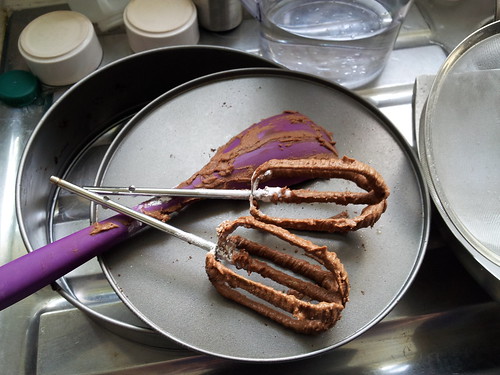
Wrangling the wodge of dough from the mixing bowl was awkward, and then it kind of sat in a big sticky messy lump in the middle of the cake tin. It didn't really look like any kind of proto-cake so I sort of splatted it out a bit. Not squished it flat or anything, but made it a bit more circular and more evenly shaped. I probably should have taken a picture before it went into the oven, but it was already in the oven when I realised that, and even I know you're not allowed to keep opening it.

The time it took to bake was longer than the time I needed to find instructional videos on how to check a cake is done and how to get it out of the tin. I have a springform cake tin with a removable base, so getting the cake onto the cooling rack was remarkably easy. A couple of people have already expressed jealousy about my cake tin. Seriously, it cost less than the cake ingredients. If you enjoy baking, and are frustrated by normal tins, then just get one.

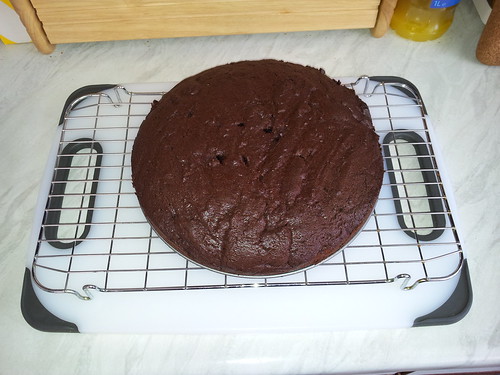
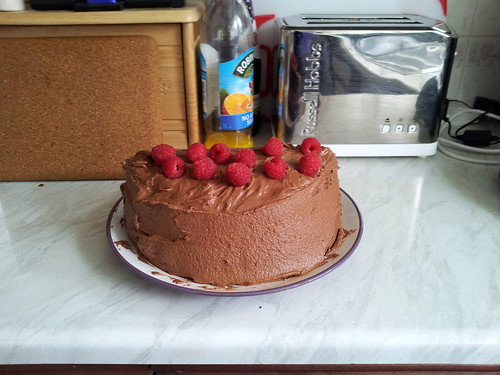
And lo! Cake! Properly baked, not dry, not burnt, not soggy!
cake

There was, however, one small problem.
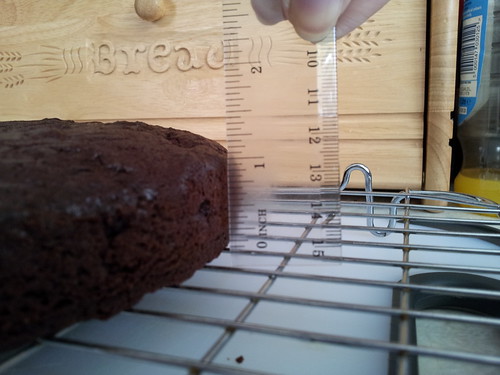
vertically challenged
At just an inch and a half in height, the stage of the recipe that called for cutting the entire cake in half horizontally was going to be more of a challenge than this novice could handle. Happily, I'd been looking for a way to avoid that particular challenge anyway, so it didn't take me too long to decide that actually, I'd just cut the cake in half the easy way, and stack the halves into a semicircular cake.

I mixed up the filling and while that was chilling in the fridge, I had my lunch:
mmm

It was very tasty.

Finally, it was time to assemble the cake.

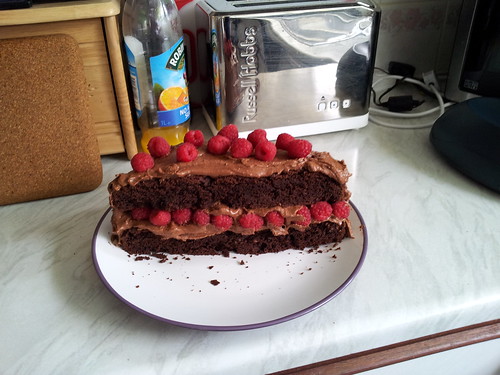
From this side it pretty much looks like chocolate mousse with cake somewhere in the middle...
chocolate mousse with cake inside

... but from the other side it looks much more cakelike.
side view

If I was doing it again, I would probably try and get a smaller cake tin. I also think that while the whole raspberries look good on the top, for inside the cake, making it a sandwich of chocolate filling on one side and raspberry jam on the other would work better than thick chocolate filling with whole raspberries added.

I have a great sense of accomplishment for having successfully made a cake. All things considered, though, I probably won't be doing it again. The cost of ingredients, the pain, the time, the cleanup, are just all too much for what's basically a pretty mediocre cake. In future I will continue to outsource all of my cake requirements to the lovely experts at Sweet As.

Friday, May 04, 2012

Naidex 2012

On Wednesday, I went to Naidex National at the NEC, Birmingham.

I have to say, Naidex itself wasn't as good as last year. Last year, I saw all sorts of innovative products and came home with lots of literature and a wish-list as long as my arm. I also picked up goodies like the National Trust's Access Guide, and was able to have demonstrated to me how much more comfortable an ergonomic office chair can be. A number of stallholders were communicating on Twitter, having actual conversations with people who said they were going to Naidex, encouraging them to come and say hi at their stall, and I dropped in on several of them. There were also a few inventor/entrepreneur types there, interested to hear ideas about what products we'd like to see in the future. I felt like I was the target market as a disabled adult in charge of her own home, equipment and finances.

This year was different. Only one company - PoolPods - engaged with me on Twitter. Their product, while I'm sure it's lovely, isn't really relevant to me - but I thought I would say hello anyway. Except I couldn't find them! Step One was easy, finding them in the list of exhibitors, they were listed under "P" for "PoolPods", simple. Stall G82. Step Two was slightly more difficult, trying to find Stall G82 on the printed room plan, but after a bit of hunting I spotted it tucked somewhere at the back of the hall. But Step Three, actually finding that stall? Couldn't do it. There were frequent traffic jams because a small cluster of two or three people standing in front of a stall could block half the aisle. Add to that the lack of signposting or labelling of the aisles (would it be so hard to have North-South aisles numbered 1, 2, 3, and East-West aisles labelled A, B, C?), the manoeuvrability issues of many attendees (wheelchairs don't tend to sidestep well, mobility scooters are often quite long) and the usual pedestrian traffic flow problems (people stopping for a chat on a busy intersection), and it was nigh-on impossible to follow a planned route to a particular point on the map. Nor was it possible to just wander up and down the aisles until you found what you were looking for - the layout was confusing, the aisles weren't continuous, and stalls faced all directions. There were several stalls I saw twice or three times and others I didn't see at all.

The small, interesting vendors with "everyday" disability products (such as Trabasack and DisabledGear) didn't seem to be present this year. I also felt that there were fewer stalls aimed at "people like me". For instance, I saw umpteen companies offering incredible, amazing off-road wheelchairs, powerchairs, hand-cycles and suchlike. We're talking massive knobbly off-road tyres, aggressive-looking LED arrays and exciting metallic paint finishes. That's great, but these aren't the sorts of chairs you can use for your everyday needs. You couldn't ride them into Starbucks, or a high-street shop, or a work meeting, or your kid's school for the parent-teacher evening. They also probably won't fold down to fit in the boot of the average Ford Focus, either. They're aimed at people who are disabled but who also have TENS of THOUSANDS of pounds to blow on leisure equipment over and above what they use every day. This made me feel sad. I mean, on the one hand it's terrific that disabled millionaires have so many choices of how to spend obscene sums of money, but on the other hand, products like comfortable wheelchair jeans are going to be far more relevant for far more people.

But! That was only part of why I went. The other part was to have the opportunity to meet up with other disabled people, and that was managed with great success. One is a very good friend who I have met before on several occasions, and we had a much-needed cup of tea together that in itself made up for the disappointment of the exhibition. Another person I have "known" and considered a friend for many years, but only online, and my PA tells me that my face lit up like a Christmas tree when I saw her for the first time. Others had familiar names and I'm pleased to be able to add faces. Eventually our group - consisting of two powerchair users, two manual wheelchair users (myself included), one person using a mobility scooter, and two people without any visible mobility aids at all - made our way into a well-known pub/restaurant chain for lunch.

Incidentally, I still get a thrill from that. Us being able to go and have lunch together in a pub is concrete proof that campaigning for equality works, has worked, and can continue to work. There's still a way to go, but it would have been unthinkable thirty years ago.

The meal was not spectacular. The company and the conversation were. There's an unusual sense of freedom when socialising with other disabled people, because you can actually go ahead and talk about disability issues without having to draw a diagram of the welfare/social care systems, and without being pitied, and without having to listen to any ablesplaining about how surely X doesn't happen any more, and the real problem is Y, and if you try Z it'll all be sorted out. No one feels the need to make the stupid jokes about running over people's toes and there's no sense of being the "odd one out". For me, it's also really refreshing to socialise in a role other than as "Steve's wife" - Steve is a nice person and so are his friends, and I like spending time with them, but it's a completely different thing to socialising as purely myself.

Of course we're all rather wiped out now. For spoonies, a look around an exhibition followed by a couple of hours having lunch and a chat with half a dozen friends can have repercussions for days on end. It's embarrassing to think about how long it's taken me to write this post. Nevertheless, I still think that despite the disappointment of the exhibition itself, the day was worth it.